![[Sidebar]](/standard/image/sidebar.gif)
![[Theater]](/standard/image/headers/theater_header.gif)
| hot links | listings | reviews |
Poetic power
Julie Harris returns with The Belle of Amherst
by Johnette Rodriguez
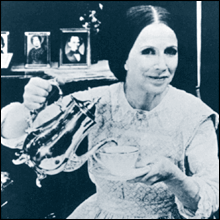
Julie Harris
When Julie Harris appeared in William Luce's The Belle of Amherst in 1976, she won her fifth Tony Award, the most ever won by a performer. Now, at 75, she has reunited with one of the play's original producers, Don Gregory, and its original director, Charles Nelson Reilly, for a 25th anniversary tour which spans seven months and 15 cities. One of those stops is Providence, where Harris will appear at Rhode Island College on Wednesday, January 31.Harris's career has been broad and deep, encompassing theater, film and television. Among a raft of roles, she fondly remembers her 1950 portrayal of 12-year-old Frankie Addams, in Carson McCullers's The Member of the Wedding; her Tonywinning role as St. Joan in Jean Anouilh's The Lark; the comedy Forty Carats (her third Tony) and the musical Skyscraper (a Tony nomination). Harris was heralded just last summer for her performance in The Beauty Queen of Lenane at the tiny Wellfleet Harbor Actors Theater. Perhaps her most well-known screen role was as Abra, opposite James Dean, in East of Eden. She has appeared in numerous TV specials, and she did a seven-year stint in Knots Landing.
Though she was almost 100 years away from the 1883 setting of Luce's play, and though she was worlds away from the life experience of a shy spinster in Amherst, Massachusetts, Harris made the character of Emily Dickinson come alive, with Dickinson's insatiable curiosity about life, her vivacity, her dedication to her poetry. Emily Dickinson (1830-1886) was an active participant in her community and its social life and traveled in her 20s to Boston, Washington, D.C. and Philadelphia. But some time after 1860, she decided to stay at home, in Amherst, in the family home with her sister Lavinia, retreating from visitors to her room, where she turned out 1775 poems, only 10 of which were published (anonymously) during her lifetime.
In his play, Luce gives many clues to this mysterious self-imposed seclusion, distinctly viewing it as a reasonable choice on Dickinson's part, given her sensitive nature and her pressing need to write. The Belle of Amherst is so skillfully woven from Dickinson's letters and poems that it's hard to know where her words leave off and Luce's pick up. He has created an amazing portrait of a dynamic young woman, a play filled with many characters and much drama, though it is performed by only one actor.
The following is taken from a recent phone conversation with Julie Harris, speaking from her home in West Chatham, Massachusetts.
Q: What originally drew you to Emily Dickinson?
A: The power of her poetry and her originality and her spirit and her great humor. All of those things. Her independence. By that I mean in her day in the 1850s, religion was a very, very strong influence and all of her family -- mother, father, brother, sister -- belonged to the church. Emily somehow resisted. That strong Calvinist religion didn't appeal to her, so she simply didn't become a member of the Church. She said, however, that she always had by her bed the Bible and Shakespeare.Q: When did you first encounter her poems? Her letters?
A: When I did a recording of her poems and letters for Caedmon in the late '60s. I began reading her letters and they made such an impression on me. I loved her way of expressing herself. After I made the second record, someone asked me to do a school program, and I did that on Long Island for a while Then I was asked to do a benefit for a church group one Sunday night at the Booth Theater. Charles Nelson Reilly came to see that. He fell in love with Emily Dickinson and that was the beginning of the quest to make her life into a play.Q: What affinities did you have with her or do you have with her?
A: I didn't really think of her as someone like me. She was so unlike me. I have no ability to write. I'm not an original thinker. I just admired and loved her. She was an extraordinary artist.Q: But don't you think there's something universal in what she says in her poems and in this play?
A: Certainly. She appeals to everybody because she expresses what we all feel. There's a poem . . . (Harris takes a breath and delivers all 16 lines of the following poem, as if she were speaking her own thoughts to an intimate friend.)
There's a certain Slant of light
Winter Afternoons --
That oppresses, like the Heft
Of Cathedral Tunes --
. . . When it comes, the Landscape listens --
Shadows -- hold their breath --
When it goes, 'tis like the Distance
On the look of Death
Q: What feels different for you as you approach the play this time?
A: There are different facets of the play and the story that I guess take on significance. I don't know that I really feel differently about it. I always felt very strongly about the woman and the play and her work and I still do. Perhaps even more so.Q: How do you feel about being on tour again?
A: I love to work in different theaters. I like the experience of traveling to different parts of the country. I love every aspect of the theater. I love seeing different stages and theaters. We have some extraordinary theaters in this country.Q: Do audiences respond differently in different places?
A: The impression of this play is almost universal. I've rarely done the play anywhere where it wasn't perceived very well. It's exciting to experience that all over the country. That's why I'm doing it.Q: Do you think that live theater will be lost amidst our fascination with screens, film, TV or computer?
A: I don't think it ever will. It's a social thing. We like to tell stories to each other. Theater is just a glorified aspect of storytelling. Children still perform plays in their home. They put up theater and say, "I'm going to do it this way."Q: You've done so many things in theater, film and television. Which do you prefer?
A: I began in the theater. It's so different from film. You're telling the stories live. Once the piece is rehearsed, you can't go back and say, "I'll try that again," or "Let me do that over again." Normally, we can't do that when we're on the stage. On film, of course, you do small moments. You take a day to do several themes.Q: We seem to understand, in our society, that artists never retire, that their work is their soul. Do you have any plans to stop performing?
A: I don't want to stop until I can't remember lines. In many of these cities, we have five performances on the week-end, and that's tiring, especially when it's only you. But I think it would wear out a younger person too.Q: What do you hope people take away from The Belle of Amherst?
A: A woman in Seattle in October said, "This play is all about love,isn't it?" Yes, that's what it's all about -- that extraordinary current that comes out from her work.Q: Do you have a favorite poem of Emily's?
A: Of the over 1000, there are so many.(Then, in her characteristic soft raspiness and faultless diction, Harris recites the following poem to its end, seven more four-line verses after these.)
I measure every Grief I meet
With narrow, probing, Eyes --
I wonder if It weighs like Mine
Or has an Easier size.
I wonder if They bore it long --
Or did it just begin --
I could not tell the Date of Mine --
It feels so old a pain --
I wonder if it hurts to live --
And if They have to try --
And whether -- could They choose between --
It would not be -- to die --
Q: It's amazing the wisdom she acquired within that one house in Amherst.
A: Yes. She knew it all. She knew it all.
The Belle of Amherst will be performed on Wednesday, January 31 at 8 p.m. at the Auditorium at Rhode Island College's Roberts Hall. Call 456-8144.
![[Footer]](/standard/image/footers/theater_footer.gif)
| home page | what's new | search | about the phoenix | feedback |
Copyright © 2001 The Phoenix Media/Communications Group. All rights reserved.