![[Sidebar]](/standard/image/sidebar.gif)
![[Television]](/standard/image/headers/television_header.gif)
Jazz in black and white
Ken Burns's epic look at America's music
by Jon Garelick
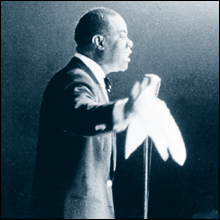
Louis Armstrong
Ken Burns's 19-hour PBS documentary Jazz (which airs in 10 parts beginning this Monday, January 8, at 9 p.m. on WGBH Channel 2, and on WSBE Channel 36 on Friday, January 19, at 9 p.m.) looks at its subject as a social force. Which is odd when you consider that jazz has been a marginal taste at least since the bebop era, when it moved from the ballroom to the club, became concert music instead of dance music, and was codified as "art."But Burns, collaborating once again with the historian Geoffrey C. Ward, makes a strong case. Jazz -- both the book by Ward (published by Knopf) and the film -- is not a musicological study or a music-appreciation class as might be presented by Leonard Bernstein or Gunther Schuller. Not that there's no discussion of musical issues (it would be impossible to watch all 19 hours of Jazz and not understand why Louis Armstrong is great). But Jazz is a popular history about jazz's force as a popular music -- and words like "joyful," "liberating," and "ebullient" are just as important to it as "arpeggio," "chord," and "mode." Burns's various commentators argue for jazz not only as spiritual expression, as the quintessentially American art form, but as a metaphor for democracy itself. "It's an improvisational art, making itself up as it goes along -- just like the country that gave it birth," the narration tells us; it rewards "individual expression" but demands "selfless collaboration." It's just jazz, you might tell yourself -- "something to dig on," as saxophonist Steve Lacy once said. But in Burns's hands, jazz is America's story. He's fighting the Civil War all over again.
Burns has been criticized for his uniformly solemn approach, whether his subject is the Civil War or baseball or women's suffrage. And here it is again -- the momentous narration ("Nothing like it had ever been recorded before") as the camera endlessly caresses the details of sepia photographs. But unlike what happened with the invented Appalachian fiddle music of The Civil War, this time Burns has jazz, and the music saves him. (How can you be solemn when Louis Armstrong is all over the soundtrack?) Despite its length (every episode is nearly two hours long), much of Jazz soars on a wave of ebullience -- that word that gets used in one form or another throughout. The synching of sound to image is always evocative and often insightful. We listen to the narration of Louis Armstrong's achievement, see the mix of old concert footage and still photographs of musicians in dancehalls, see lamplit streetscapes in New Orleans, Chicago, and New York. The music on the soundtrack builds -- "Chimes Blues" or "Heebie Jeebies" or "Up a Lazy River" -- and then, with the music unbroken, we cut to the young jazz-violinist Matt Glaser, bearded, grinning, listening to the very same Armstrong vocal we are, and he begins to parse Louis's phrasing for us (the "abstraction" of the popular melody to a single note of driving swing, a bar or two of "no time," a stunning resolution), catching the trumpeter's almost indecipherable spoken aside and translating for us, not in a pedantic way, but joyful, as if he were sharing a gift. And he is.
Armstrong is the protagonist of Jazz. In a typical narrative trajectory, the protagonist enters in chapter one, and by the end of the story he's been transformed. In Jazz, Armstrong enters at the end of Episode #1, in 1917. But by the time he dies, in Episode #10, in July of 1971, he hasn't changed a whit -- it's America that's been transformed. He has changed us. With the force of his rhythmic conception, he's changed the way jazz musicians play and desentimentalized the way popular singers sing. If anything is a definition of the American spirit, it's the explosiveness of those notes, the sense of aspiration they convey, as if, Gunther Schuller once wrote, "such notes wish to burst out of the confines of their rhythmic placement." And, of course, he's forced America to confront how it sees the negro race.
Armstrong is the great hero of Jazz and -- as in The Civil War -- race is the series's great theme. Again and again, the theme threads its way through the documentary: slavery and the first "free" jam sessions in New Orleans's Congo Square; the way white musicians wanted to play with blacks but were forced apart by segregation (the great line often quoted by Armstrong, but omitted from Jazz, about his first meeting with his lifelong friend Jack Teagarden: "You're a spade, I'm an ofay -- let's blow"). And the subject of race instigates the film's first great cinematic moment. We've been following the adventures of the all-white Original Dixieland Jazz Band -- the first band to record jazz (in part because the black cornettist Freddie Keppard turned down a recording offer) and the first to score a hit, with "Livery Stable Blues." It's a jovial history. Until we get to the end of their story. The trumpeter Nick LaRocca has been retired from jazz, but he reacts violently to the first published histories of jazz: "My contention is that the negroes learned to play this rhythm and music from the whites. . . . The negro did not play any kind of music equal to white men at any time." From that statement, Burns cuts to Wynton Marsalis, who, as one of the regular commentators throughout the film, is a presiding spirit. Marsalis -- the great pedagogue of jazz, the Leonard Bernstein of our era -- is speechless. He looks away, eyes closed. Burns holds the shot. For a moment it's unclear whether Marsalis is going to speak or burst into tears. And then he composes himself and provides a conciliatory explanation.
At one point Marsalis offers a loving disquisition on the character the film calls "the first truly great white jazz musician." Bix Beiderbecke -- the child of middle-class German-American Presbyterians from Davenport, Iowa -- pursued Armstrong with a passion. "You're going out every night," offers Marsalis, "you're hearing the greatest musician in the world play -- Louis Armstrong -- and all you want to do is be able to play like him. But you've been told, `Don't listen to them. These are niggers and they ain't playing nothing, and this is some coon music and it's all a joke.' But you realize it's the most serious thing you've ever encountered in your life. And when you realize that, you realize that you, too, are a part of it. And that's got to be exhilarating and terrifying at the same time. Because to accept jazz music means that at a certain time you have to accept something about the humanity of the United States negro."
For Beiderbecke, choosing jazz was in every way a subversive act. And that act -- that subversive act of jazz -- is the film's life blood. "Jim Crow," the film reminds us, was first a minstrel hit -- the first jazz hit, if you will. Jazz tells us the story of young Charlie Black, a white man who paid 75 cents to see Louis Armstrong play in 1931 in Austin. Black, we're told, was not particularly prejudiced -- he lived in the segregated South but liked blacks and "loved a few of them," including an old man who taught him how to play harmonica. But, writes Black, Louis Armstrong, "was the first genius I had ever seen. . . . It is impossible to overstate the significance of a sixteen-year-old Southern boy's seeing genius, for the first time, in a black. . . . Blacks, the saying went, were `all right in their place.' [But] what was the `place' of such a man, and of the people from which he sprung?"
Black went on to become a lawyer on the team that argued Brown v. Board of Education before the Supreme Court. You wouldn't believe that if it were made up, and you won't see it in conventional histories of jazz as music, but here it is. As Burns and Ward present one jazz great after another, the social power of the music becomes manifest: the integration of the Savoy Ballroom in Harlem; Duke Ellington on being denied rooming in the hotels where his band played ("I took the energy it takes to pout and wrote some blues"); Billie Holiday's "Strange Fruit"; Armstrong refusing a State Department tour of Russia because of the Little Rock school-desegregation crisis; the citizens of Occupied France taking to jazz both because it's American and because it's about "freedom"; Dave Brubeck returning from World War II where he served with his integrated orchestra only to find his black war buddies refused service at a lunch counter; Miles Davis, "the black man who lives like a white man." And time after time, we see white musicians and white audiences looking at black musicians and saying, in the words of interviewee Gerald Early, "That's me." Or as Stanley Crouch tells the camera: jazz is "both ethnic and all-inclusive . . . negroid with a welcoming quality that you associate with the highest form of civilization."
Burns's blend of imagery and music is a tonic: the everyday street scenes that are accompanied by Ellington's strolling "Echoes of Harlem"; bebop mixed with quick-cuts of the nuclear era and the suburban homogenization of the American landscape; the shrill cry of Archie Shepp's protest music played over funeral footage from the civil-rights era. But once jazz gets beyond the indomitable optimism of Armstrong and Ellington, the issues become confused, and -- perhaps to its credit -- so does the film. Burns's whole thrust has been about jazz as a metaphor for the great American experiment, about how the margins of society were brought into the mainstream. But after bebop, as the music itself slowly becomes marginalized, the points of view clash. Until now, the film has been about jazz, in the words of Marsalis, as an act of "negotiation" -- the process of various agendas coming together and "dealing" with their differences. Ellington, we're told, presided over a fractious band, even manipulated standoffs between musicians so that he could get a better performance. Under Duke's guidance, performance resolved both musical and personal differences.
Having bought into the Marsalis/Crouch vision of jazz as civilizing, as democracy in action, Burns seems a bit lost as the music fragments, as rock and roll subverts jazz's power of miscegenation and the music itself fragments into warring camps. It's as if he couldn't acknowledge that sometimes the bassist punches out the trombonist and the show's over. That sometimes jazz -- like a lot of great art -- springs from a well of irrationality. That it can be democratic and subversive, social and anti-social. The film's witnesses -- Crouch, Early, Glaser, Gary Giddins -- are uniform in their praise of Armstrong, Ellington, Charlie Parker. But now it begins to break apart. Gerald Early argues that bebop, aside from its purity and beauty, attracted a lot of alienated beatniks. Allen Ginsberg is interviewed and made to look foolish (admittedly that's not always difficult to do) because he doesn't "understand" the discipline of bebop -- as though the poet of "Kaddish" and "Aunt Rose" didn't understand artistic discipline. The critic Gene Lees makes his only appearance in the film simply to refute the music of Cecil Taylor. It's pointed out that the Art Ensemble of Chicago once played to an audience of three people in their own home town, but not that there were plenty of occasions when thousands came to their concerts, or that sometimes Coltrane and Mingus played to half-full clubs as well. After fusion, the Marsalis generation is given credit for revitalizing jazz "without electric instruments."
The ambivalence boils over in the segment on Charlie Parker. Here was some of the greatest jazz ever made, most agreed, but, as Roy Eldridge is quoted as saying, good as the boppers were, they "closed more clubs than they opened." What conclusions can we draw when one of the greatest jazz musicians of all time was virtually unknown in his time and was, by his own disavowal, also "the world's greatest junkie"? Burns wants us to all get along, but he's honest enough to let the jazz proselytizers slug it out on film, even if it ruins his thesis. After bringing us all together, the music served, as the narration puts it about Ornette Coleman, "to inspire and divide." Of course, for the last 35 years, it's been rock and roll that's served to inspire and divide on a mass level, and now it's white rockers who want to be black hip-hoppers. Robert Palmer subtitled the accompanying text to his own PBS documentary, Rock and Roll, "An Unruly History." Perhaps Burns could take a lesson from Palmer and show a little more faith in the marginal, the honest undercurrent of artistic struggle and achievement that never does reach a mass audience but is a social force just the same, and is just as necessary to the great American experiment.
Copyright © 2001 The Phoenix Media/Communications Group. All rights reserved.