![[Sidebar]](/standard/image/sidebar.gif)
![[Features]](/standard/image/headers/features_header.gif)
The shape of things to come
Redistricting -- the redrawing of the state's legislative lines every 10 years -- has a notorious history. This time around, a grassroots coalition is trying to ensure a fair and open process
by Ian Donnis
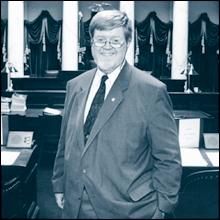
J. Michael Lenihan
On the outs with the state Senate leadership in the early '90s, Senator J. Michael Lenihan (D-East Greenwich) found that his legislative district -- once a relatively compact mass in East Greenwich and part of Warwick -- had been stretched during redistricting into five different communities. Some of the most egregious excesses were scaled back after protest, but Lenihan still wound up with an unusually contorted wrap-around district -- "sort of like a giant C" -- stretching through four municipalities, from Goddard Memorial State Park in Warwick to the tip of the Jamestown Bridge in North Kingstown.Of course, this kind of attempt to make life difficult for a political enemy wasn't anything new when it comes to redistricting. The redrawing of legislative lines takes place every 10 years -- after the release of updated US Census figures -- and it's widely considered the most vicious kind of political manipulation. Serious flaws in the process have long played a role in Rhode Island's history, influencing events from the adoption of the state Constitution in 1842 to the sway held by Democrats over the General Assembly since the "bloodless revolution" of 1935. And in 1982, the perils became all too familiar when a fatally flawed state Senate redistricting plan wound up in federal court, causing a six-month delay in elections, lame duck representation through the 1983 legislative session, and a $1.5 million tab in court and special election costs for taxpayers.
By contrast, Rhode Island was one of a small number of states where the redistricting of the early '90s -- the first time that the General Assembly's discussions on the subject were open to the public -- wasn't challenged in court, and relatively few complaints were aired at the time. Senate Majority Leader William V. Irons (D-East Providence) cites the turn around as evidence of the legislature's ability to conduct a fair and open process. "What I think it said is, the leaders of the '92 time frame had learned a lesson from the '82 debacle," he says. Not everyone is so sanguine, though. H. Philip West, executive director of Common Cause of Rhode Island, points to the extension of Lenihan's district, and a number of other strangely shaped jurisdictions, in describing the '90s redistricting as far more flawed than many recognized at the time, albeit a vast improvement over the calamity of '82.
Regardless of the quality of the last effort, no one disputes that redistricting, a contentious effort during the best of times, will be more painful since it will coincide for the November 2002 elections with the voter-mandated downsizing of the General Assembly -- the House from 100 to 75 representatives, and the Senate from 50 to 38 members. The impending loss of General Assembly seats has some legislators, most notably Irons and House Majority Leader Gerald M. Martineau (D-Woonsocket), publicly stressing the importance of building fairness and credibility into a process that will cause inevitable unhappiness. Irons and Martineau have also pledged that enabling legislation for a redistricting commission will become law before the General Assembly adjourns for the summer -- a necessary step, in the minds of watchdogs, to ensure adequate time for sufficient public hearings and other measures to engage the public.
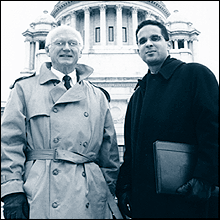
The commitment by the legislative leaders to move ahead in a timely fashion encouraged West and Angel Taveras, the respective secretary and chairman of the Fair Redistricting Coalition, a grassroots organization formed last fall, which has brought together more than 20 civil rights, good government, and community groups to promote integrity in redistricting. At the same time, West is disheartened that a bill backed by Irons lacks a clearly defined public process, including a minimum number of meetings to be held by the redistricting commission, and enough legal standards -- particularly the use of statistical sampling to account for growth in minority communities -- for the drawing of districts.
Phil West and Angel Taveras
Irons takes some umbrage at suggestions "that the legislature needs to be guarded against." "We're not about to build a mousetrap that fails," he says. "The question is, `Do you get treated fairly during the process?' "But without more specifics in the legislation, "the public is really at the mercy of the leadership," says West. "If it's not in the law, that standard will not be utilized by the commission." He likens the lack of details in the Senate leadership's bill to taking part in a Super Bowl without knowing the boundaries or the rules governing the use of instant replay. "The more you can spell out the rules in advance," West says, the greater the chances for ensuring a fair process.
The Fair Redistricting Coalition's four elements of fair redistricting are broadly contained in the acronym DOS -- for diversity, openness and standards -- and the coalition and its member organizations plan to continue pushing for the inclusion of their recommendations in the bill expected to emerge in the coming months. Final maps for new legislative districts must be adopted by the General Assembly before the June 2002 deadline for the filing of candidates' papers for the fall 2002 elections.
Among other things, the coalition wants the General Assembly to share its traditional authority for appointing members of the redistricting commission, and to provide public access to redistricting data and software, so that civil rights groups and other community organizations can develop their own maps and present them to the redistricting commission. But the outlook is uncertain at best -- and this is exactly why the coalition is trying to rally more public participation in the process.
There's considerable behind-the-scenes pressure being exerted at the State House as the Fair Redistricting Coalition's bill, which was introduced by Lenihan and four cosponsors in the Senate in early February, has struggled to attract sponsors in the House. The fear on the part of lawmakers, even those most supportive of the coalition's mission, is that their districts will be wiped out if they cross the legislative leadership. There's also the accompanying drama of whether the beginning of the end of John B. Harwood, the powerful House speaker, is in motion. As with many things, the devil is in the details, and redistricting is a far more detailed process than most.
One insider recently compared redistricting to the proverbial elephant that no one at the State House wanted to acknowledge. "People are saying, `It's not really a factor,' but it is," the source says. "It's a factor in just about everything right now. If that group [the Fair Redistricting Coalition] can stay together, that's the best hope of this thing not being done behind closed doors."
THE TENSE DYNAMIC associated with redistricting is most evident in the Fair Redistricting Coalition's quest to find sponsors to introduce the group's bill in the House of Representatives. State Representative Joseph S. Almeida (D-Providence), was expected to sponsor the bill, but didn't show for a February 6 news conference to promote the legislation at the State House. Almeida, who denies he was pressured by House leaders, blames the situation on a miscommunication with West, and flatly told the Phoenix recently that the bill will be introduced by Representative Aisha W. Abdullah-Odiase (D-Providence). The thing is, Abdullah-Odiase had indicated to me about 90 minutes earlier that she remained undecided about sponsoring the bill. "My whole issue is, I don't want to have something dumped on me at the last moment when I didn't have any input on the legislation I'm being asked to introduce," she says.
Complicating the matter is the fact that the districts of Almeida, Abdullah-Odiase and another prospective sponsor, freshman Representative Leon Tejada (D-Providence) -- minority legislators who are philosophically in tune with the intent of the Fair Redistricting Coalition's legislation -- are bunched together in Providence and could be inviting targets for elimination or alteration. But after several weeks of discussions, Tejada is expected to sponsor the coalition's bill.
Legislative leaders -- in contrast to the coalition's call for a 13-member commission with five members appointed by the governor and the state's congressional delegation -- also seem unlikely to relinquish their appointing authority for the redistricting commission. This much is clear: although the state Constitution calls for legislative districts "as nearly as equal in population and as compact in territory as possible," this has never been a guarantee against strangely shaped districts and other defects.
Then there's the Harwood factor. Although the speaker has long flexed his authority with relative impunity, he's been the subject of a growing amount of unfavorable attention since his wife, Patricia Lynch Harwood, was appointed to a $100,000-a-year state court job in December. In February, the Providence Journal reported that John Harwood, as a private lawyer, has represented four cases before state agencies over which the General Assembly has oversight -- a possible violation of state ethics law. Harwood, who didn't return a call from the Phoenix, told the Journal that he believes he didn't do anything wrong, citing an exception that allows legislator-lawyers to appear in a "state court of public record."
The perception of an overly Machiavellian speaker -- and a subsequent ethics complaint filed by Operation Clean Government -- could mark the start of a threat to the Harwood's eight-year tenure. "At some point, you reach a critical mass," says a State House source. "You [representatives] start to get the phone calls at home -- `Why are you supporting the speaker?' I don't know that we're there; I do know that we're closer to it than we've ever been before. I do think he's weakened; I don't know that he's fatally wounded. It will really depend on what develops over the next month or so -- the ethics charge, how it plays out."
Still, despite the uncertainty, Harwood remains the speaker, and as such, he'll have a serious influence on the redistricting process, from the setting of standards to the selection of commission members.
The Fair Redistricting Coalition has a measure of support from those representing another minority constituency in Rhode Island -- Republicans -- who hope their long-suffering party will benefit from an anticipated Census increase in the number of residents in the southern and western parts of the state. A GOP redistricting bill in the House differs from the coalition's legislation by supporting the General Assembly's selection of the redistricting commission. But GOP leaders support the coalition's other recommendations to a large degree. House Minority Leader Robert A. Watson (R-East Greenwich), calls the emphasis on public access and public participation "essential ingredients for any commission, if it's going to have any credibility in the eyes of the public."
It helps that the Fair Redistricting Coalition, perhaps the first such effort of its kind in Rhode Island, has assembled a far-flung alliance of more than 20 organizations, from Operation Clean Government and the League of Women Voters, to the Green Party of Rhode Island, the Sierra Club, Urban League, Liberian Youth Organization, American Civil Liberties Union, and the Rhode Island State Council of Churches. The group formed last fall after West, in his capacity at Common Cause, reached out to Tomas Avila, then the executive director of Progreso Latino, the Central Falls-based advocacy group for immigrants.
Still, it's worth noting that some other groups -- such as the Rhode Island Public Expenditure Council, the Democracy Compact, the Rhode Island AFL-CIO, the Northern Rhode Island Chamber of Commerce, and the Greater Provider Chamber of Commerce -- have spurned invitations to join the effort. "We're an independent organization," says Gary Sasse, RIPEC's executive director, who is optimistic about the forthcoming redistricting because of the relative merits of the last effort. "We'll comment as we deem appropriate." George Nee, secretary-treasurer of the AFL-CIO, says the union need not join the coalition to share the group's point of view. Matthew Brown, executive director of the Democracy Compact -- credited with bringing 55,000 new voters to the polls in November, says the compact is in the midst of a planning and transition stage that precludes meaningful participation in the coalition. James G. Hagen and John C. Gregory, the respective heads of the Providence and northern Rhode Island chambers, didn't return calls seeking comment.
Meanwhile, back at the State House, few legislators will publicly acknowledge the tension associated with the run-up to the redistricting -- a process, unlike the debate over separation of powers -- that can't be stymied and put off. But West doesn't hesitate to cite fear as a driving force. "By that I mean the fear of legislators that unless they go along with the leadership, their districts will be wiped out," he says. "That's a real fear . . . It's a very risky thing for people to step out on this. I've seen more pressure around this legislation than around anything else I've done up there."
THERE'S A RICH vein of lore associated with redistricting, going back to the tale of how former Massachusetts Governor Elbridge Gerry's political party created a blatantly partisan reapportionment plan in 1812. As the story goes, one of the most strangely shaped districts resembled a salamander, sparking the introduction of the term gerrymandering to commemorate Gerry's chicanery. The story might be quaint, but it's obviously harmful to the public interest when elected officials use their influence to achieve unfair advantage in voting districts for certain individuals and constituencies. And there's no shortage of such instances in recent Rhode Island history.
As a maverick senator during the leadership of Rocco Quattrocchi, Democrat Richard Licht, for example, was put in the same district as Lila Sapinsley, then the Senate minority leader, in the '82 redistricting. And although Licht successfully challenged the scheme in court, there are still a number of Providence-based districts whose margins now bleed into neighboring Cranston, North Providence and Johnston -- a not so subtle attempt, critics believe, to allow white flight voters maintain influence in the face of growing Latino and black communities in the capital city.
This isn't to say that the curious manipulation of a district spells inevitable doom for a target. Lenihan, for instance, faced the challenge of traversing a district covered by three local papers and two editions of the Providence Journal after his Senate District 22 seat was sharply altered in the early '90s, but he's gotten to know the district well while building stature and emerging as favorite reformer of Operation Clean Government. Irons, whose constituency in East Providence was extended into Pawtucket in the redistricting of '92, says the key to electoral success remains for lawmakers to stay in close touch with their constituents.
At the same time, redistricting affects a variety of outcomes, from the spending of state dollars and the equitable representation of different groups, to the ability of one party to dominate a state. "Redistricting is one of those factors that can have enormous influence, just because if you control the boundary lines, you can control who wins," says Darrell West, a political science professor at Brown University.
But despite the inherent flaws of vesting responsibility for redistricting with state legislatures -- once described by the National Municipal League as an "illogical system in which legislatures are the judges and juries in a matter of highest importance to themselves" -- Rhode Island and most other states continue to do so. And in a country where it's hard enough to get citizens to vote, it remains a challenge to get people involved in the process -- a situation that clearly aids a particular ruling political party and other beneficiaries of the status quo. "Too often, people don't even understand that it's happening or that it's relevant," says Phil West. "Apathy is the enemy here."
This is where the Fair Redistricting Coalition comes in -- promoting an open process, trying to expand public participation and countering an initial perception that legislative downsizing will be harmful to minorities. Census data, due to be released in mid-March, is expected to reflect increases in Rhode Island's black and Hispanic communities. The growth has sometimes fostered tension between the two groups -- a twist on old ethnic rivalries between the Irish and Italians -- and one of the coalition's committees is geared toward mediating these kinds of disputes.
Downsizing actually grew out of the banking crisis of the early '90s and the all-too-evident need -- backed in 1993 by a 16-member commission -- to modernize a legislature plagued by a heavy dose of conflicts. Even last fall, Taveras, a son of Dominican immigrants, who energized Latino and other voters during his congressional campaign, was making the case that the pressure to rescind the downsizing really came from legislators who were troubled by the prospect of competing against their colleagues and friends, or in a larger district with unfamiliar communities.
According to West, details aren't available on the effect of downsizing on minority representation in legislatures. But figures compiled by Common Cause and the Rhode Island Public Expenditure Council show that the percentage of female lawmakers increased after legislatures in Massachusetts and Illinois respectively downsized in 1978 and 1982. In Massachusetts, the percentage of women lawmakers increased to 16.5 percent in 1985, from five percent in 1975, and in Illinois, the percentage increased to 16.9 percent, from just over five percent. The respective increases of 11.5 and 11.8 percent exceeded the national figure of almost seven percent over the same period.
The Fair Redistricting Coalition's member organizations are pursuing outreach efforts to expand public involvement. Getting this to become a reality won't be easy, but an energized core of people could enhance the prospects for a fair and open redistricting process.
The mixed outlook might be best expressed by state Senator Charles Walton (D-Providence). Even though he's one of the five Senate cosponsors of the bill backed by the Fair Redistricting Coalition, he has serious doubts about whether the legislation will serve as anything other than a casual suggestion for the legislature. But as the only black member of the Senate, he knows all too well the need for greater minority representation at the State House. "In the final analysis, what we're working on here is the democracy having the benefits for all the people," regardless of their status, Walton says. "If we don't have any a system where people feel they can participate in democracy, all we're doing is reversing the years."
Ian Donnis can be reached at idonnis[a]phx.com.
Copyright © 2001 The Phoenix Media/Communications Group. All rights reserved.