Capitol Records: 1942-2002
(Capitol)
This austerely packaged and straightforwardly titled six-CD set is a refreshing
example of truth in advertising. As it says on the side of the box, you get six
decades' worth of material released by Capitol Records, all neatly divided up
by decade, on the occasion of the label's 60th anniversary.
If there's a tale to be told here, it's a simple one about the continuing
evolution of pop music, from the novelty swing of a single like "Cow-Cow
Boogie" by Freddie Slack & His Orchestra featuring vocalist Ella Mae Morse
to the suave crooning of Frank Sinatra on "Young at Heart" to the sunny
melodies of the Beatles' "A Hard Day's Night" and on up through the splintering
of styles that characterizes today's multifaceted market for mainstream music.
So as the set progresses through each of its six decades, the style of the
individual CDs become less and less cohesive; disc six ranges from the
bombastic hip-hop of the Beastie Boys' "Sabotage" to the rootsy rock of Bonnie
Raitt's "I Can't Make You Love Me" to the Britpop of Robbie Williams's
"Angels." Not that that's any real surprise: there's no such thing as a
contemporary major label that isn't a fully diversified enterprise. The days
when a label like Atlantic or Capitol had a distinctive identity ended long
ago. This set, however, is a well-crafted reminder that even big labels like
Capitol have their roots in a more quaint time, before pop music was the big
business that it had become by the end of the '60s.
-- Matt Ashare
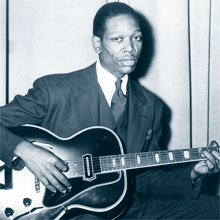
Charlie Christian
The Genius of the Electric
Guitar
(Columbia/Legacy)
For this set, Columbia emptied its vaults of every last scrap of music it had
recorded by Charlie Christian -- the first great electric-guitarist in jazz --
between 1939 and 1941. With 17 previously unissued tracks and 27 takes issued
in the US for the first time, The Genius of the Electric Guitar is
exhaustively archival, but most of it is absolutely essential American music.
Christian served his journeyman years in relative obscurity in the Southwest,
where blues and Western swing bands already included electric guitars. He was
in the national spotlight for less than four years with the Benny Goodman
Sextet before he died of tuberculosis, at age 25, but it's hard to think of
another jazz musician who made a comparable impact in so little time. Christian
played exquisitely sculpted solos that combined bluesy bite and dancehall
rhythmic drive with a smooth linear flow and a harmonic daring that made him a
favorite of the young bop revolutionaries.
The four CDs in this set include early gems like "Flying Home," "Seven Come
Eleven," and "Good Enough To Keep (Air Mail Special)" with the Goodman sextet
featuring Lionel Hampton. Christian probably reached the peak of his short
career with BG's band (whose line-up included Ellingtonian trumpeter Cootie
Williams), and the classics "Wholly Cats," "Royal Garden Blues," and "Benny's
Bugle" are all found here. There's also a studio session with his idol,
saxophonist Lester Young, and four big-band sides, where you'll find the
remarkable "Solo Flight." The accompanying booklet features a delightful
anecdotal essay by Les Paul, rare photos, and a thoroughly researched biography
by Christian authority Peter Broadbent.
- Ed Hazell
Herbie Hancock Box
(Columbia/Legacy)
Herbie Hancock is one of the architects of modern jazz -- from his first hit,
1962's "Watermelon Man," to 1965's Maiden Voyage to his work with the
Miles Davis quintet and his R&B-flavored hits like "Chameleon" and
"Rockit," he's created new templates for one subgenre after another: hard bop,
modal jazz, jazz-rock fusion.
So why am I not happier with the four-CD Herbie Hancock Box, which
samples 23 albums from 1976 to 1988, mixing equal parts Herbie the progressive
acoustic jazzhead and Herbie the MTV-propelled funkmeister? Maybe it's because,
as I look back now, so many of Hancock's tracks with the post-Miles
retrospective supergroup VSOP sound manic and shrill. Maybe the band simply had
trouble in the mid '70s readjusting to acoustic jazz after the jazz-rock fusion
they'd helped create, but drummer Tony Williams (a genius by any other measure)
hammers away tonelessly and Ron Carter's overamplified bass groans and moans
tastelessly. Both are way up front in the mix while Hancock and trumpeter
Freddie Hubbard limp along in the background. Even the usually infallible Wayne
Shorter strains for stadium-size gestures. The electric hits like "Chameleon,"
"Rockit," and the updated "Watermelon Man" and club-ready R&B like "Stars
in Your Eyes" have dated badly, with cheesy fluttering keyboard effects,
simplistic harmonies, and Gavin Christopher's banal vocals. You can find better
acoustic Hancock on his Blue Note box of a few years ago or on his sessions
with Miles, and better Herbie of any kind at just about any live date he
chooses to play. The clear plastic box is as cool-looking as it is impractical
-- another designer's triumph of form over function.
-- Jon Garelick
Frank Sinatra,
Frank Sinatra in Hollywood
(1940-1964)
(Reprise/Turner Classic
Movies Music)
No matter how many times you've heard Frank Sinatra singing George and Ira
Gershwin's "I've Got a Crush on You," you've never heard it the way you get to
hear it here: the original version from the 1952 Sinatra vehicle Meet Danny
Wilson, with ebony harmonizers the Ebonaires backing up the crooning ivory
Sinatra. Boasting 160 tracks spread out over six discs, Frank Sinatra in
Hollywood is full of stunning moments like this, when standards get
destandardized (Sinatra's precise and precedent-setting pass at "Someone To
Watch over Me" with the Warner Bros. orchestra in Young at Heart) and
songs heard only on screen and never released as commercial recordings finally
get their due. Perhaps most notable are the nine songs from Finian's
Rainbow -- an animated 1954 film scrapped for its threatening
racial-brotherhood bids -- that pair Sinatra with Oscar Peterson, Ella
Fitzgerald, and Louis Armstrong (the latter on the scatting duel "Ad Lib
Blues").
Sinatra in Hollywood covers two decades of Sinatra films -- from 1941's
Las Vegas Nights to 1964's Robin and the 7 Hoods -- and it's the
first attempt to save his audio contribution to the big screen from the
disintegration of nitrate film and the ruin of studio playback discs. All the
songs here are, in some way, digital makeovers of original elements; they've
been cleaned up, edited, remastered, and stripped of film dialogue and sound
effects so they stand alone as musical recordings. But producers Didier Deutsch
and Charles Granata don't weed out all of the talk -- there are Academy Award
acceptance speeches, radio-interview promos, dialogue excerpts, and vocal
outtakes, including Dean, Sammy, and Frank trying to get right the "Don't Be a
Do-Badder" finale that brings the set to an intimate close.
-- Josh Kun
Freedom: Songs from the Heart of America
(Sony Legacy)
A companion piece to the upcoming PBS documentary Freedom: A History of
US, which chronicles America's various struggles for independence, this
three-disc, 67-song box provides a corresponding overview of historic country,
folk, roots, and gospel music. The first disc addresses the period between the
Revolution and the Civil War, the second the first half of the 20th century,
and the third the civil-rights movement and Vietnam. It's a lot of ground to
cover in three discs, and the result is more comprehensive than imaginative,
emphasizing usual suspects like Pete Seeger, Bob Dylan, and the Carter Family
and familiar material like "When Johnny Comes Marching Home Again," "This Land
Is Your Land," and "Strange Fruit."
Nevertheless, most of the material here is by almost any measure great, and any
collection that features Louis Armstrong, Benny Goodman, and Leadbelly has a
lot going for it. There are even some welcome surprises, like the Suzanne
Vega/Dan Zanes version of "Erie Canal," and Terence Trent D'Arby's
collaboration with Booker T. & the MG's on "A Change Is Gonna Come." But
Freedom is poorly served by its neglect of rap and by its reliance on
material recorded by Sony artists -- Billy Joel's "Goodnight Saigon" and even
Living Coloür's "Open Letter (to a Landlord)" simply aren't in a league
with Billie Holiday's "Strange Fruit."
-- Allison Stewart
Grand Theft Auto: Vice City
(Epic)
As video games get badder, they get bigger. And no company has pushed more
aggressively in both directions than New York's Rockstar Games. The latest
installment in its Grand Theft Auto series -- Vice City -- is
regarded as the single largest consumer product launch of this past year, and
that's due in no small part to its almost-unchecked capacity for random
violence and questionable decision making. And like a movie of comparable
financial size, this video game comes with its own soundtrack.
Vice City is set in 1986 Miami, and this collection of CDs is as
faithful to the moment as the game's slick, neon-happy visuals. Each of the
seven discs is devoted to a separate specialty "station," all of which are
available in the game itself, each with a virtual host who navigates through
the songs. Metal is represented in both its dark form (Slayer, Megadeth) and
its more cartoonish variety (Twisted Sister, David Lee Roth). On the new-wave
disc, A Flock of Seagulls and Tears for Fears sidle up to lesser-knowns like
the Buggles and Romeo Void. The "slow jam" channel includes R&B crooners
like Luther Vandross and power-poppers like Toto and John Waite. The
"hip-hop/electro" channel (which wisely includes Cybotron and Hashim) is hosted
by real-life old-school radio jock Mr. Magic, who brings a clever touch of
reality to this virtual world. More impressive still is the inclusion of an
"Espantoso" channel, which features Cuban funk and jazz (including bands like
Irakere), turning what could have been generic era revivalism into an
appropriately regional affair.
-- Jon Caramanica
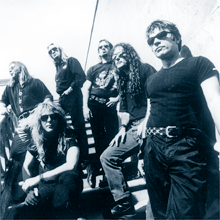
Iron Maiden
 |
b>Iron Maiden
Eddie's Archive
(Columbia)
Two years ago, Iron Maiden fans rejoiced when the band released Brave New
World (Columbia), their first new studio album with frontman Bruce
Dickinson and guitarist Adrian Smith in almost a decade. The group and their
legendary mascot, Eddie, have been smiling ever since: they've reclaimed their
status as one of metal's most popular touring acts, re-released their entire
back catalogue, and watched their influence spread to a new generation of
bands.
Which makes now the perfect time for the release of Eddie's Archive, a
six-disc box set of rare concert recordings and B-sides encased in a silver
casket with Eddie's head on the cover. Extra goodies include a parchment scroll
of the band's family tree and a crystal shot glass with Eddie's face peering up
through the base. Maiden have released plenty of killer live albums over their
career, from the '85 classic Live After Death to this year's Rock in
Rio (both Columbia). But this is the first extensive overview of the band's
early days, going all the way back to a punked-up BBC radio performance from
'79 with original frontman Paul Di'Anno. The compilation's holy grail is a pair
of sets from the triumphant tour that followed the release of Maiden's '82
breakthrough album, The Number of the Beast (Columbia), both of which
find the band at their tightest and Dickinson at his shrieking best. The
B-sides collection is Maiden's answer to Metallica's cover-songs album,
Garage Inc. (Elektra): it's an inspired romp through the secret history
of Eurometal that proves Metallica aren't the only Budgie fans in the world.
Iron Maiden have always been a collectors' favorite, and Eddie's Archive
is their ultimate collectible.
-- Sean Richardson
Say It Loud! A Celebration of Black Music in
America
(Rhino)
I can't think of another 108-track compilation that rocks from bottom to top.
Or, to put it more correctly, from Scott Joplin's 1916 piano-roll recording of
"Maple Leaf Rag" to Coolio's 1994 hip-hop trip "Fantastic Voyage." Okay, so I
like to skip over Andraé Crouch's lifeless gospel-chorus arrangement "My
Tribute," but the rest of these six CDs is pure gold. Sometimes commercially,
since it sports hits like the "Theme from Shaft," Hank Ballard's
"Twist," and Harold Melvin's "Wake Up Everybody (Part 1)," and almost always
spiritually, from Bessie Smith's "St. Louis Blues" to jazzman Charles Mingus's
"Wednesday Night Prayer Meeting" to contralto Marian Anderson's "Sometime I
Feel like a Motherless Child" and Queen Latifah's "Ladies First."
Boasting a handsome, thoughtfully penned 72-page book of accompanying notes and
essays, this set taps African-American performers in every musical genre,
though the accent is on the blues, soul, R&B, and jazz that evolved
directly from roots in the Motherland. And though the songs play through in
chronological order, they slide from style to artist without a ripple. They
tell the story about the flowering of black culture in America -- which of
course means much of what's come to be identified as the heart of American
culture. As the spindly-legged blues of Son House gives way to the
sophistication of Lena Horne and Charlie Parker solos into Ike Turner's "Rocket
88," we hear the black American spirit beginning to assert itself. It's
full-blown by the time we reach James Brown's "Say It Loud -- I'm Black and I'm
Proud" and Sly Stone's "Don't Call Me Nigger, Whitey," on through the last
disc, with Living Coloür's "Elvis Is Dead." There's also a handful of
spoken-word cuts to illustrate the tenor of the changing decades. Sometimes
they're the thoughts of a Dade County janitor beaten by Jim Crow's wings.
Sometimes they're the speeches of leaders like Martin Luther King and Tom
Bradley. They're part of the music too -- the voices behind the voices that
sing this ongoing story.
-- Ted Drozdowski
Jellyfish
 |
Jellyfish
Fan Club
(Not Lame)
The same label that brought out the lovingly exhaustive Posies box two years
ago now does the same favor for the second most shamefully overlooked West
Coast pop band from the same era. Jellyfish made only two albums during their
time together -- roughly 1989 to 1994 -- so this four-disc box more than
triples their released output. (Roger Manning and Andy Sturmer were the
masterminds, but bandmembers Jason Falkner and Jon Brion went on to
higher-profile solo careers.) Although it hasn't got any album tracks, almost
every song from the two discs shows up in a live or demo version, usually both.
And between discarded songs and live covers, you get virtually everything that
Jellyfish even thought of playing.
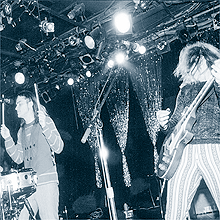
All this for a band that got booed the last time they appeared in Boston? Sure enough. Just consider what kind of underground
rock was all the rage in the early '90s. Then consider Jellyfish's habit of
coming on stage in Day-Glo H.R. Pufnstuf outfits, singing impeccable three-part
harmonies, and playing roller-rink keyboards instead of distorted guitars. What
you've got is one of the gutsier bands of their time. They cover three Paul
McCartney songs, but only one is by the Beatles rather than Wings. They also
cover Abba and Argent, and they make frequent reference to Queen, ELO, and
Supertramp. The masterstroke, however, is "Sugar & Spice" -- an album track
by the Archies (who even knew there were any?) done with no irony whatsoever.
How were Jellyfish able to pull off a sound this unhip? Their original songs,
for the most part, were exquisite. Their one semi-hit, "That Is Why," still
ranks as the best thing Cheap Trick never did. "Calling Sarah" and "New
Mistake" embody romantic exhilaration as well as anything being written then or
now. None of the demos is quite as polished as the album versions, so
non-converts will first want to seek out the original albums (especially the
debut, Bellybutton). But fans will find this set as impeccably detailed
as everything else Jellyfish did, with full history, photos, and notes by the
bandmembers for every track. And if there is some repetition on the four discs,
nobody ever died from an overdose of bubblegum.
-- Brett Milano
Classical round-up:
Furtwängler, Richter,
Christmas
Lights
Since Christmas celebrates a historical event, two of my box-set suggestions
for the classical-music lover focus on performances by great musicians of the
past. First off are two volumes of Recordings, 1942-1944 by the
German conductor Wilhelm Furtwängler and the Berlin Philharmonic
(Deutsche Grammophon, nine CDs total). The war gave Furtwängler's
conducting an extra edge, and some of his most vital performances are here,
including a profound reading of the Brahms B-flat Piano Concerto with Edwin
Fischer.
Also in the "legendary" category is the muscular pianism of Sviatoslav
Richter, and the Praga label offers 15 CDs worth of his performances at
Prague's Spring Festival. It's a gold mine whose repertoire runs from Haydn to
Scriabin and includes five wonderful discs of Beethoven plus Mussorgsky's
Pictures at an Exhibition, a Richter specialty.
Finally, to bring things back to the season at hand: the Christmas
Lights collection (Harmonia Mundi, four CDs) gathers some of the
Baroque's best non-Messiah holiday music, including Schütz's
setting of the Nativity story, Charpentier's Pastorale on the Birth of
Christ, and three Christmas cantatas by Bach. Performances are of the
historically informed variety under such luminaries as Philippe Herreweghe and
William Christie.
-- David Weininger
Issue Date: December 13 - 19, 2002