"What are your favorite films in the Competition?" Nothing quite yanked the
chain of my European critic friends at the 2002 Cannes Film Festival like my
post-September 11 Stars-and-Stripes answer: "The American movies rock!"
It was true, Eurodudes. Our USA went three for three where it counted: on the
red carpet at the Palais in the Official Competition. Alexander Payne
(Citizen Ruth, Election) triumphed with his third consecutive
clever, acerbic comedy, the Jack Nicholson-starring About
Schmidt. Paul Thomas Anderson (Boogie Nights, Magnolia)
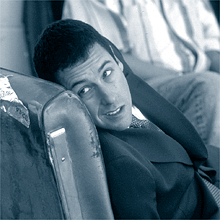
used Adam Sandler brilliantly in his loopy farce Punch-Drunk Love. And
Michael Moore's Bowling for Columbine, the first documentary selected
for the Competition since Louis Malle's Le monde du silence in the
1950s, was, mains-down, the most popular film among Cannes
first-nighters. The gown-and-tuxedo crowd rewarded Moore's agit-prop movie
essay about the violence-soaked USA with a 10-minute standing ovation.
More? Cambridge's own Frederick Wiseman, in a Bogie-in-Casablanca white jacket,
was much applauded for his out-of-Competition La dernière lettre,
a one-actress (the Comédie-Française's Catherine Samie) dramatic
recitation of a poignant epistle written by a Russian-Jewish woman doctor
before her fatal deportation by the Nazis. (The theatrical version was
presented here by the Market Theater last June.) And when Martin Scorsese
unveiled a 20-minute "extended preview" of his mid-19th-century-set The
Gangs of New York, this time it was the international press that cheered.
"In 1970, I first picked up a book, The Gangs of New York, by Herbert
Asbury," Scorsese said in introducing his sneak preview. "I read it in one day
and knew that sometime I'd have to make a movie about this extraordinary time
in American life. It's been in my heart and mind since growing up. These
stories permeated the hallways of my street." The bloody confrontations between
immigrant mobsters over pre-Tammany Hall turf are filmed by Scorsese in
spectacular epic fashion, an operatic amalgam of Eisenstein, Leone, and
Visconti. Most impressive of the leads is Daniel Day Lewis as a blustering
top-hatted thug, "The Butcher," who fights young, moody Leonardo DiCaprio (a
flagrantly Oedipal battle) for bed rights to Cameron Diaz (miscast in a period
film?) as the Gypsy-like hussy-with-a-heart.
Finally, Woody Allen left his beloved New York for an opening-night screening
(out-of-Competition) of Hollywood Ending, which had already played
theaters back home to tepid reviews and terrible box office. The French weren't
crazy about the movie either, but Allen tamed skeptics with his diplomatic
words at the press conference. "The French people have been so supportive of my
films and so affectionate to me that I thought I'd show some gesture of
reciprocity and gratitude," he explained of his unexpected live appearance on
the Côte d'Azur. "When I made Hollywood Ending, I looked at it and
thought that the Cannes audience would get a particular enjoyment out of it."
Since he was already there schmoozing, Allen reached out also to placate film
critics: "They've been very generous to me. They've chosen to overlook my
faults and emphasize what I do well. I have a very, very positive view of
them."
Merci, Woody! But back to the Cannes films that count. For About
Schmidt, filmmaker Payne took the story of Louis Begley's 1996 novel --
about a newly retired, vaguely anti-Semitic New York WASP lawyer who's
perturbed that his daughter wants to marry a déclassé Jew in his
firm -- and deftly switched the tale to his home town, Omaha. Now Schmidt
(Nicholson) is a retiring insurance executive whose lifetime of WASP politeness
boils over with his realization that he loathes his wife and hates his dreary
life, and he fumes that the fiancé (Dermot Mulroney) of his daughter
(Hope Davis) is a total dimwit. If the filmic inspiration for Election
was the screwy comedy of Preston Sturges, this Payne and his co-screenwriter,
Jim Taylor, weld world classics (Kurosawa's Ikiru, Bergman's Wild
Strawberries) onto a wryly amusing Midwest road movie. The newly widowed
Schmidt tools through Nebraska, Kansas, and Colorado in his 30-foot Winnebago
seeking the Meaning of Life.
"They write a strong script and Alexander is a firm director," Nicholson said,
happy to be working with a younger-generation cinéaste with a proper
respect for the history of film. "Alexander is a throwback. He's going to Il
posto because I love that movie." Sure enough, Payne and Taylor showed up
for a revival screening of Ermanno Olmi's 1961 Italian masterwork and stayed to
the end even though the film had no English subtitles. Payne ignored the
unwritten film-festival rule that directors should be totally solipsistic,
concentrating at every moment on promoting their own work. Instead, he came
early to Cannes and stayed on to watch other directors' movies.
And Punch-Drunk Love? You'd have to go way back to Jerry Lewis's romance
with Shirley MacLaine in Artists and Models (1955) to find an equivalent
for Paul Thomas Anderson's inspired pairing of low comedian Adam Sandler and
artsy thespian Emily Watson. Sandler is cast as a loner who flees a gaggle of
phone-sex thugs and his San Fernando Valley family of interfering sisters to
race off to Hawaii with Watson. He's as funny as in his zany comedies but also
deeper and sweeter, and Watson's blue eyes mist over. Anderson, doing without
the excesses of Magnolia, tells his screwball tale in 92 streamlined
minutes, and it plays like a minimalist cartoon. The face-to-face showdown
between Sandler and arch-villain Philip Seymour Hoffman feels like Bugs versus
a sputtering Yosemite Sam.
"Why would you cast Adam Sandler in your movie?" an anti-Happy Gilmore
type of journalist asked Anderson. "Adam makes me laugh," was the filmmaker's
reply. "I loved him on Saturday Night Live, I love his movies, love
watching him. His walk is kind of funny, his ears are kind of funny. I haven't
seen Adam naked, that might be funny."
"He's a good man," Sandler said of Anderson. "I saw his movies, admired them.
Punch-Drunk Love is the first time I kissed a girl in a movie and my
girlfriend didn't get mad at me. She watched it and said, `Wow.' "
About Schmidt and Punch-Drunk Love, works of integrity, reveal
some unfortunate Hollywood shading in their final seconds. I wish that Jack
Nicholson would nod knowingly (Ozu-like) instead of bawling at Payne's
conclusion, and boy gets girl too cutely and smoothly in Anderson's finale. But
I was more bothered by the shaky elements in Bowling for Columbine,
though I'm thrilled that this radical film will be immensely popular and
politically important when it hits theaters in America.
What does Moore do? In broad strokes, he compares Canada, our gentle, caring,
pacifist, happy welfare state to the North, with our own venal,
individualistic, blame-the-victim, shoot-before-you-are-shot USA, with the
killings at Columbine High being a kind of metaphor for America today. Himself
a rifle champ and a member of the NRA, Moore goes after right-wing NRA
president Charlton Heston, even tracking the stooped actor to his lavish
Beverly Hills home and attacking old Moses on camera. Good stuff, except the
documentary is shot through with questionable factoids. Is it true, as Moore
insinuates, that practically all murders in the USA are committed by stupid
white guys in the suburbs? Is it true, as Moore shows on camera, that people in
Toronto don't even lock their doors? I took a quick survey of five Torontonians
at Cannes: to a man, they bolt their portals back home in Ontario. (Or is that
because they're paranoid film critics?)
And the Cannes jury awards? Paul Thomas Anderson shared the Best Director
prize, and Bowling for Columbine won a Special Jury Prize. (Translation:
those on the jury bickered over whether it was a muckraking masterpiece or
tabloid muck.) Jack Nicholson was shut out as Best Actor for About
Schmidt. Wait for next year's Academy Awards.
The Palme d'Or for Best Picture went to Roman Polanski's The Pianist,
which was perhaps the 15th most interesting film in this year's excellent
Competition. There's nothing wrong with Polanski's true-life tale of a famous
Jewish-Polish pianist who miraculously survived the Nazis, including an escape
from the Warsaw Ghetto. But the telling of this story is strangely detached and
dispassionate, especially when you realize that Polanski himself was a Jewish
survivor whose mother died in the camps. Does it sound cruel for me to say (and
I'm a Holocaust-obsessed Jew) that we've seen this before, and that The
Pianist plays like a slick, competent, post-Schindler's List
TV-movie?
How did it win? My guess is that the jury split 6-3, picking The Pianist
over the Grand Prix official runner-up, Aki Kaurismäki's deadpan Finnish
comedy The Man Without a Name, which was probably the favorite (though
not mine) among film critics at Cannes. That would mean, I'm guessing, that
jury president David Lynch and the jury's two serious directors, Raoul Ruiz and
Claude Miller, voted for the Kaurismäki. But they were ganged up on by a
coalition of actresses (Sharon Stone, Christine Hakim, Michelle Yeoh) and
middlebrow filmmakers (Walter Salles, Bille August, Régis Wargnier) who
fell for the big-themed Polanski.
My Palme d'Or? Either of the American features would do, or Michael
Winterbottom's 24 Hour Party People, which gloriously celebrates two
decades of the Manchester rock-and-rave scene. It will open this summer in the
USA.
Gerald Peary can be reached a gpeary@world.std.com.
Issue Date: June 7 - 13, 2002