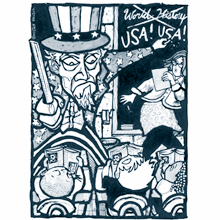
President Bush has found a new and unlikely weapon in his war against
terrorism: American history.
A subject often shrugged off by students and even their parents, history is
seen by the administration as a key to cementing the domestic defense to last
year's attacks. In September, Bush endorsed a new series of history projects,
backed by the National Endowment for the Humanities (NEH), from an essay
contest for students and a study of 100 historic documents, to lectures about
American heroes, for a yet-to-be-determined cost.
"Our history is not a story of perfection. It's a story of imperfect people
working toward great ideals," Bush said while unveiling the initiative during a
Rose Garden ceremony. "This flawed nation is also a really good nation, and the
principles we hold are the hope of all mankind. When children are given the
real history of America, they will also learn to love America."
Bruce Cole, Bush's NEH chairman, touted the rationale for the agency's new
orientation during testimony to a congressional subcommittee in March. "The
terrorist attacks were an assault on our principles, our heritage of freedom,
our history and culture," Cole said at the time. "To defend our country, we
must first understand it. A knowledgeable citizenry is essential homeland
defense."
But the NEH's new concentration on American history has alarmed some experts
in the humanities, which include the study of history. The criticism is
particularly strong in Rhode Island. The critics fear the effort could subject
historical research to a patriotism test, and put an isolationist spin on the
overall humanities field, which, they believe, should be international in
scope.
"I'm uneasy at the notion of the federal government trying to bend the
humanities to develop a stronger patriotism," says Eugene B. Mihaly, chairman
of the Rhode Island Committee for the Humanities (RICH), which receives more
than half of its funding from the NEH.
Galen A. Johnson, a University of Rhode Island philosophy professor and a past
chairman of RICH, worries that the effect could "politicize the humanities
under the rubric of `homeland defense.' " The humanities, says Johnson, "are
neither political or non-political. They are inquiries into human questions
common to all cultures and people."
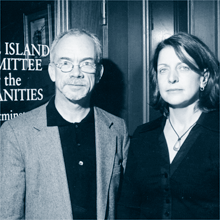
Galen A. Johnson and M. Drake Patten / Photo by Richard McCaffrey
 |
Even if there is no political bias injected into the history initiative, the
critics say, simply earmarking money for one subject means there will be less
for others. They wonder whether only a standard view of early American history
will be emphasized at the expense of an evolving, ever-changing understanding
of the country's past.
The critics also suspect the new policy may be influenced by Lynne V. Cheney,
the wife of vice president Dick Cheney. Lynne Cheney, a prominent and outspoken
conservative during debate on the nation's culture wars, is a former chairwoman
of the National Endowment for the Humanities.
But it's the use of the term "homeland defense" that seems to have most
touched a nerve.
"I do fear greatly the linkage of `knowledge' to homeland defense," says M.
Drake Patten, RICH's executive director. "Or maybe I just find the historic
meaning of `homeland' to be so profoundly loaded and offensive that I just
can't get past it. I would prefer, for example, to see the regular NEH mission
-- which reads something like: `A democracy demands wisdom and knowledge in its
citizenry,' because that transcends the dangerous temptation to surrender the
public intellect to event and crisis."
THE HUMANITIES seem an unlikely battlefield for the national response to the
attacks on the World Trade Center and the Pentagon on September 11, 2001.
The term "humanities" is so little understood that many state councils and the
NEH itself include definitions on their Web sites, just so casual visitors will
know what they're talking about.
The humanities include literature, history, philosophy, law, archaeology,
religion, ethics, and art criticism. A distinction is drawn from other arts,
such as painting, the purview of the NEH's twin agency, the National Endowment
for the Arts and its state councils.
The NEH itself is but a tiny part of the federal government, with a budget of
about $126 million. And the Rhode Island Committee for the Humanities is
struggling to get its budget to equal $1 for each of Rhode Island's one million
residents. RICH currently spends $905,000, with about $465,000 from its NEH
allotment, the rest from private sources.
Regardless of concerns about funding, humanities advocates are passionate
about their subject and its importance.
"NEH programs have a huge impact and can change the things people are talking
about," says Jamil S. Zainaldin, president of the Georgia Humanities Council,
and a supporter of the Bush program. For example, Zainaldin cited the impact of
the public television series The Civil War, created by filmmaker Ken
Burns and supported by NEH, which drew 38 million viewers in 1990.
Cole, a scholar whose field is not US history but Italian art, told
congressional budget overseers that study of the humanities "not only helps us
to develop wisdom, it also enables us to better understand our nation's history
and institutions, as well as the history and culture of other nations."
The NEH's initiative, dubbed "We The People," has three thrusts:
* Grants to teachers, academicians, filmmakers and others for projects that
"explore significant events and themes in our nation's history and that advance
knowledge of the principles that define America."
* An essay contest for junior class high school students, with a $5000 prize
for the winner.
* An annual lecture on "Heroes of History."
In addition, Bush announced an "Our Documents" program backed by the National
Archives and other agencies to focus national attention on 100 "milestone"
documents, ranging from the Constitution to the 1965 Voting Rights Act.
The critics do not fault NEH for responding directly to the September 11
attacks. Many of the country's state humanities councils did precisely that.
RICH sponsored a series last winter called "Beyond the Mosque" which included
films, lectures, literature, art exhibits, and music to offer Rhode Islanders
the chance to "move beyond the tragedy by learning more about the Islamic
world."
Similarly, the Massachusetts Foundation for the Humanities created a program
called "Understanding Islam." David Tebaldi, executive director of the
Massachusetts foundation, says some critics wondered whether the focus on Islam
was a backward way of trying to excuse the attacks. "We are not suggesting that
at all," Tebaldi says. "We are suggesting people should understand Islam and
not be predisposed to stereotypes about Muslims, and that they should form
their own opinions . . . based on real knowledge."
The Rhode Island council is also cosponsoring an ongoing series of panel
discussions at AS220, the nonprofit arts organization in Providence, focusing
on security concerns (the Phoenix is also a cosponsor). But the subjects
-- such as 1960s fallout shelters and the tough anti-drug laws that started to
come about in the 1970s -- are not tied directly to September 11.
Nor does RICH frown on Rhode Island-centered or American history. In the
coming year, it will promote programs on the question, "What is Freedom?" One
of its continuing programs involves having professional actors travel to
schools to perform mini-plays about controversial aspects of Rhode Island
history, such as the use of child labor in the first textile mills.
So what's the difference between the local and national approaches?
Patten, RICH's director, says humanities programs should be allowed to explore
controversial issues without constraining themes. The natural inclination of
humanities organizations is to promote far-ranging debate, she says. "Does the
NEH need to change anything in response to 9/11?" Patten asks. "For us, we
changed nothing about what we did or how we did it. We just used our usual
strengths to look at a very hot topic calmly and thoughtfully; business as
usual."
Mihaly, RICH's chairman, says he's concerned about an approach that might
narrow the focus of the humanities to US subjects without a broader, global
context.
"The word that best sums up where I stand is `concern,' deep concern," Mihaly
says. "This is a time when we need to be asking questions about who we are, but
I think very carefully. And I don't think we should be closing international
doors. We should be opening them."
For example, Mihaly says, RICH donated money to a film festival sponsored by
the Cambodian Society of Rhode Island on October 25 and 26. The topics include
the Khmer Rouge genocide in which 1.7 million Cambodians died.
While the films examine a "terrible national trauma in another country,"
Mihaly says, the subject is pertinent to Americans because of the effect of the
Vietnam War on Cambodia. "I would not want us to get into a situation where
priorities are set and agendas are set so there would be no funds to do
something like that," he says.
A former Peace Corps director in Tanzania, Mihaly operates a small
international management-consulting firm from Rhode Island. "I think it is the
role of RICH and councils elsewhere to be part of a dialogue about things
people are concerned about, not only in America," he says, "but in Asia and the
rest of the world."
AT THE CRUX of the debate is the fact that history often depends on who's
telling it.
Take, for example, the debate over a possible United State attack on Saddam
Hussein's Iraq, which President Bush describes as a danger to the US and world
peace. Few dispute Saddam's brutal record. However, there's another side of the
story that goes unmentioned by the administration: that Saddam has received
substantial help and backing from the United States in the past.
Newsweek magazine last month reported that several administrations have
seen Saddam as the lesser of evils in the Middle East and provided him with
intelligence, perhaps arms and even possibly allowed him to import ingredients
for biological weapons. "Through years of both tacit and overt support, the
West helped create the Saddam of today, giving him time to build deadly
arsenals and dominate his people," the magazine reported.
Meanwhile, a University of California political scientist points out the irony
of President Bush backing a plan to study historic American documents while at
the same time trying to seal some presidential papers. "These are the same
people who are illegally, by executive order, sequestering stuff which, in
fact, is in the public domain," says Nelson W. Polsby, a professor at the
UC/Berkeley campus. He was referring to a November 2001 executive order that
allows former presidents to keep their presidential papers secret beyond the
current 12-year limit if they cite national security concerns.
Noting what he sees as the contradiction of holding some papers secret and
venerating others, Polsby says the 100 important documents project sounds like
a "feel good" program. "We don't need them to tell us that the Constitution is
important," he says. "We need them to follow the Constitution."
Polsby took a somewhat jaundiced view of the Bush administration's push on
history, saying, "At best, they are sending a mixed message."
But the NEH's new emphasis on American history is similar in some ways to the
Soviet Union's launch of the Sputnik satellite in the 1950s, which gave
education advocates the leverage to push for more spending. Polsby says using
the mantle of patriotism is nothing new for politicians of any stripe. "I don't
blame politicians for wanting to wrap themselves in the flag," he says. "It's
been done for centuries, certainly well before the formation of the United
States."
A prominent American historian, Brown University professor Gordon S. Wood,
welcomes the added attention that the NEH projects could bring to a
much-neglected area of education. "To hold a nation like ours together, kids
really need to have some sense of what our history about," says Wood, who won a
Pulitzer Prize in 1993 for his book, The Radicalism of the American
Revolution.
Wood believes efforts could be concentrated on the elementary schools, telling
children from first grade and then into higher grades about Lewis and Clark,
the Revolution, the Civil War, as well as ordinary people who shaped history.
"These are stories that are exciting and interesting, and have good guys and
bad guys," he says. "This is how little kids learn."
As for worries that the White House could dictate a particular version of
history, Wood doubts this is possible in such a vast country, where individual
teachers control the lessons. "I don't think that it's going to mean that there
is going to be policemen in the classrooms," he says. "We are too big a
democracy, with too many people involved in the thing, so it's very difficult
to control something like that."
Nor is Wood worried that scarce NEH resources will be dissipated, saying that
from his own experience, he thinks there is some "wastage." "I've been on NEH
panels," he says, "and there's an awful lot of monographs supported [by the
NEH] that disappear into the pits."
HUMANITIES OFFICIALS in other states did not voice the sharp sense of alarm
expressed by their Rhode Island counterparts, although some said there are
potential dangers.
"I can see where controversy arises out of tying the effort to defense of the
homeland," says Craig Newbill, executive director of the New Mexico Endowment
for the Humanities. "But it's not like he's [NEH director Cole] is doing it in
a vacuum." Newbill said the NEH initiative seems to fit in well with what the
agency always has done, and matches the mission of the agency.
"I'd say that it certainly is an effort on the part of NEH Chairman Bruce Cole
to respond to the national interest and priorities," he says.
Mark A. Sherouse, executive director of the Montana Committee for the
Humanities, says, "I'd say that it certainly is an effort on the part of NEH
Chairman Bruce Cole to respond to the national interest and priorities."
Kristina A. Valaitis, executive director of the Illinois Humanities Council,
says, "At first blush, I can't imagine it won't be something very good."
Valaitis says she believes the scope of the project will be "capacious as
opposed to narrow." And she says the NEH's system of reviewing grant proposals
-- which include using panels of respected scholars and experts to recommend
finalists -- will help keep the projects nonpartisan.
Douglas Quin, executive director of the North Carolina Humanities Council,
says he was "encouraged this is coming from the administration, because this
important work of the humanities is really what it means to be part of a
participatory democracy."
Quin said of the September 11 attacks, "This can't be taken for granted. The
home front needs as much attention as external affairs."
Unpleasant aspects of American history are not likely to be ignored, Quin
says. His own background includes working as the designer of an exhibit of
photographs of the lynching of black Americans.
"This is a good time to be talking about the meaning of the United States,"
says Zainaldin, of the Georgia Humanities Council, in an e-mail message and a
later interview. "We have a rare and unique system in the world. We ought to
talk about it and why we believe in it. If someone doesn't, we need to talk
about that, too. That is what is so unique."
The director of the Massachusetts humanities program, David Tebaldi, came the
closest of those interviewed to noting the concerns raised in neighboring Rhode
Island. "I think it's a good idea," Tebaldi says of the `We The People' effort.
"But I think people should be more aware of everyone's history, not just
American history."
Tebaldi praised Cole for using September 11 to focus more attention on history
and the humanities. "I applaud Bruce Cole's linking of deep understanding of
American values to this notion of homeland security," he says. "Where he fell
down was not using the obvious connection to secure additional funds for
NEH."
Still, Tebaldi says, he has some reservations.
"There is a jingoistic element to it," he says, "and what begins to get my
concern about it is where the idea originated. I don't believe it originated
with Bruce Cole, but other people connected with the current administration."
Tebaldi acknowledges that the people he refers to include Lynne Cheney, who
was NEH chairwoman from 1986 to 1993, under Presidents Ronald Reagan and George
H.W. Bush.
Tebaldi says Cheney has been a critic of so-called "multiculturalism" and that
she has wanted to place more emphasis on more traditional approaches to
American history. And during the so-called cultural wars, she was a leading foe
of leftist "political correctness" on campuses. Cheney was criticized for
making the NEH more conservative. But supporters say she kept the agency free
from the savage attacks that plagued its sister agency, the National Endowment
for the Arts.
Critics say one sign of Mrs. Cheney's possible continuing influence, beyond
her tie to the vice president, is that Lynne Munson, one of her top aides at
NEH, is now the agency's deputy chairwoman.
But the NEH administration scoffs at suggestions that Lynne Cheney still
wields power there. "I think she is pretty busy with her own projects," says
Cherie Harder, an aide to Cole.
Harder, who responded to questions after the Phoenix sought an
interview with Cole, rejects the argument that the history initiative -- which
currently has no extra funding -- has changed NEH priorities. "We don't see
this as zero sum," Harder says, referring to the "We The People" program. "NEH
always has been a proponent of trying to encourage not only broader
understanding of American history, but also of world history."
Last year, Harder says, about $24 million in NEH funds went to projects
involving the history and culture of other nations. One was for the revision of
an 11-volume encyclopedia of Islam, she says.
Nor is the "We The People" initiative intended to focus just on early American
history, Harder says. NEH hopes the grant applications will reflect the
"broadest possible swath." "Grant solicitations will go through the regular
divisions and grant process," Harder says, which includes judging by outside
panels, a 26-member endowment council, and Cole himself.
The real issue, Harder says, is improving Americans' understanding of their
country.
"There are many people of both parties and all stations in life who are very
concerned about the lack of knowledge of American history," she says. "Our
chairman has been concerned for a long time."
Nobody, including skeptics of the "We The People" program, disputes that
Americans know too little about their history. On its "We The People" Web site,
NEH includes surveys that show a gross lack of knowledge. One poll reported
that nearly a quarter of high school seniors believed Italy was a US ally
during War II.
Johnson, the URI philosophy professor and head of the university's honors
program, says he always includes a history lesson when raising new topics in
the classroom because he never can be sure students already know it. "I have
little to complain about in terms of the statement that students are woefully
behind on understanding American history," he says.
Johnson agrees that understanding one's own traditions provides a platform
from which to understand the cultures of other groups and nations. But he
worries that assessments will be made of humanities projects based on notions
of patriotism. "I just don't want to see this politicized in such a way that
the humanities become -- that there are sort of tests for the humanities
whether one is being patriotic in one's research," Johnson says.
One of his latest interests is African philosophy, Johnson says. He wonders
whether there will be room for this subject in light of the new American
history initiative.
Still, Johnson acknowledges that it's too early in the process to know how "We
The People" will affect other subjects, and he respects Cole's scholarly
reputation. "Let's just be optimistic," Johnson says. "I have to believe that
Bruce Cole is well-intentioned. I don't know him, but I do know that his area
of research is profound and not narrow-minded."
Brian C. Jones can be reached at brijudy@ids.net.
Issue Date: October 11 - 17, 2002