The deadline for registering as a mayoral candidate in Providence is less than
three weeks away -- a threshold that lends fresh meaning to the axiom about
timing being everything in politics. With the fate of Vincent A. "Buddy" Cianci
Jr. hanging in the balance at US District Court, and a number of unannounced
mayoral hopefuls watching from the sidelines, it's conceivable that June 26
might pass without a verdict in the Plunder Dome case.
Such a scenario could muddy the waters for those would-be candidates, who, for
one reason or another, don't want to run against Cianci. A conviction of the
popular incumbent prior to the deadline, on the other hand, would start a
scramble for succession, significantly expanding the field beyond the four
already announced challengers: state Representative David N. Cicilline
(D-Providence); Greg Gerritt of the Green Party; gadfly and former
representative Keven A. McKenna, a Democrat; and Christopher Young, a
little-known Democrat who ran unsuccessfully for US Senate in 2000.
Cianci remains a potent political force, and although damaged by the cascade
of negative testimony during his trial, he got a boost when Chief Judge Ernest
C. Torres threw out of five of the 17 charges against him on Tuesday, June 4.
Unlike his first administration, when 22 city employees were convicted of
corruption-related offenses, there hasn't been any kind of organized effort to
recall Cianci this time around. If the jury acquits him, it's hardly a stretch
to imagine Cianci returning for a valedictory record seventh term at City Hall.
But with the mayor's legal problems offering an obvious subtext, Cicilline,
Gerritt, and McKenna are aggressively starting to target such issues as ethics
in government, public safety, the city's fiscal concerns, under-performing
schools, and the need to bring more of the benefits of the Providence
Renaissance to the city's neighborhoods.
A Zogby poll shows that Cianci's job approval ratings remain in the "low 60s,
about where it was before the mayor's corruption trial started, but that 51
percent of city voters think it is time for a change," according to a recent
item on www.insidepolitics.org, the Web site of Brown University political
science professor Darrell West. Even with this inchoate sense of ambivalence,
the item notes, "More than 70 percent feel the city still is headed in the
right direction."
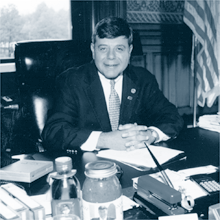
Joseph Paolino
 |
As Sunday stories in the Providence Journal and Boston Globe
pointed out on May 30, Cianci's fate essentially depends on whether the
12-member US District Court jury places more credulity in the prosecution or
defense. Asked about how the trial will affect his political fortunes, the
61-year-old mayor responds succinctly, with a semi-rueful guffaw, "That depends
on the verdict, doesn't it?"
Under the city charter, a mayor, if convicted of a felony or a crime of moral
turpitude, would be required to resign only after exhausting all his avenues of
appeal. But the Rhode Island Constitution states that "an elector shall be
disqualified as a candidate for elective [office] . . . or from holding such
office" if the person has been convicted of or pleaded nolo contendere
to a felony," or to a misdemeanor resulting in a jail sentence of six months or
more, either suspended or served. Cianci declined to comment on the steps he
might take to pursue his candidacy if convicted, describing such a situation as
"hypothetical."
For now, the local icon clearly relishes his freewheeling moments away from
the strictures of the courtroom, as during a broadcast from the Biltmore last
month of Imus In the Morning, when he can pour on his storied charm and
again proclaim his innocence. Using his formidable communication skills, Cianci
mines these early moments of what may or may not be his last campaign,
characteristically reciting a list of improvements to the city, from the latest
accolade in Money magazine to a rise in test scores for elementary
school students.
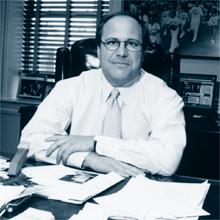
David Cicilline
 |
If he's acquitted, Cianci, as an independent, would be a sure bet to make it
to the November ballot. But even if the jury absolves him of criminal
culpability, it remains to be seen if city voters -- particularly the East
Siders who have formed an important part of his base -- will be as charitable
when it comes to the trial's squalid revelations.
Asked about elements of the trial that have sparked criticism of his oversight
of city government, Cianci says, "A lot of those things are not really true."
Certainly, defense lawyers for the mayor and his codefendants have raised fair
questions about the credibility of some, perhaps many, of their accusers. But
other unflattering things have become clear at trial -- such as Urbano Prignano
Jr.'s utter unsuitability for his previous five-year tenure as police chief --
and could become fodder for sustained fire from Cianci's mayoral rivals.
Beyond those already announced, the list of potential candidates includes
former mayor Joseph R. Paolino Jr., Frank Caprio, chief judge of Providence
Municipal Court; lawyer Angel Taveras, who ran unsuccessfully for Congress in
2000; state Senator David V. Igliozzi; city council president John J. Lombardi;
Councilman Luis Aponte, former congressional candidate Scott Wolf; Juan
Pichardo, who ran unsuccessfully for state Senate in 2000; and state
Representative Paul E. Moura.
West describes Providence's growing Latino population as the city's emerging
political class. It's no coincidence that Cicilline opened his campaign office
last Saturday, June 1 in a location on Elmwood Avenue and that his Web site
includes a Spanish-language section. An appealing Latino candidate could
certainly galvanize a heightened level of interest in the mayoral race. The
most obvious choice would perhaps be Taveras, 31, a clean cut, articulate, and
intelligent lawyer, who scored a respectable 12 percent of the vote during the
Second Congressional District Democratic primary in 2000.
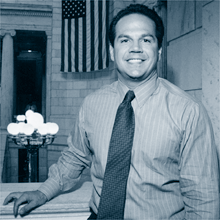
Greg Gerritt
 |
Observers question, though, whether Taveras has the inclination to be
personally involved in the integral process of campaign fundraising, and he
declines to comment on his prospective interest in running for mayor. "I'm a
lawyer and I believe in our judicial system," Taveras says, adding that he'd be
aggressively fighting if wrongly accused. "I think it's important that we
respect the judicial process."
Although it's unlikely to match the free-for-all of 1981, when 25 candidates
(a veritable who's who of people who would go on to greater prominence,
including Cianci, Paolino, McKenna, Susan Farmer, president and CEO of WSBE-TV,
and Justice Victoria Lederberg of the state Supreme Court) were in the early
running for mayor, West expects there to be seven or eight Democrats in the
primary. With such a crowded field, 35 percent of the primary vote -- a
relatively easily obtained margin -- would be more than enough for a victory.
FOR ALL THE heightened status that Providence has accrued over the last 15
years or so, the next mayor -- whether it's Cianci or someone else -- is likely
to face a formidable challenge in doing more with less. For starters, Cianci's
$528 million 2002-2003 budget proposal is based on the questionable assumption
that the state will offer an additional $30 million in aid for city schools and
other needs. Despite an infusion of millions of dollars in additional state aid
in recent years, the Providence Public Schools remain more of a failing than an
attraction. The city's pension system faces millions of dollars in unfunded
liability -- a situation that led retired municipal workers to picket a Cianci
campaign event earlier this year. Morale remains an issue in the police
department, and although Cianci says violent crime has dropped over the
long-term, his opponents cite it as a serious problem.
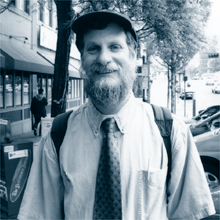
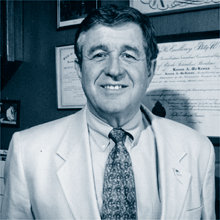
Keven McKenna
 |
Among the announced challengers, Cicilline appears to have the edge because of
his solid war chest and East Side base. But with his strong name recognition,
previous mayoral experience, and ample cash resources, Joseph R. Paolino, 47,
might benefit the most by a suddenly vacant seat in City Hall. In 1984, he won
a special election to succeed Cianci by 117 votes, and a similarly short
election season -- by a vote of five members, the city council can schedule,
within 90 days, a primary and special election -- would seemingly work to
Paolino's advantage in a been there, done that campaign. Many observers,
including Brown's Darrell West, expect Paolino to run if Cianci is convicted.
Paolino, though, sounds something of a mixed message when asked about getting
back into the ring, Saying that he supports Cianci's reelection, the former
mayor adds, "It's just plain inappropriate for people who want to speculate
about what's happening to him."
Paolino worked as an assistant to former lieutenant governor Thomas DiLuglio
at 21, was elected to the city council from Federal Hill at the tender age of
23, and the Dorrance Street office of the family business, Paolino Properties,
one of the largest owners of property in downtown Providence, is a political
junkie's treasure trove, with countless photos of local and national luminaries
(including a famous shot of Nelson Rockefeller flipping the bird) and framed
copies of old Providence Journal stories about Paolino's ascent.
Prominently displayed among these is a 1989 Newsweek cover with the
headline, "Hot Cities: America's best places to live and work," featuring
Providence at the top of a six-community list.
Despite all this, Paolino says he doesn't miss politics. "Could I envision
myself doing something tomorrow?" he asks. "I could envision it, not that I'm
looking for it. If a person can't live without politics, they don't belong in
it." Looking back on his unsuccessful 1990 run for governor, he says, "My ego
was running faster than what the reality was."
One of Paolino's obvious advantages as a candidate would be the way he ran a
scandal-free administration in taking over during what has become known as
Cianci's "hiatus." The former mayor points with pride to a municipal code of
ethics that was adopted during his tenure and points to the caliber of staffers
like his former director of administration, John Simmons, who went on to serve
as finance director for Boston Mayor Thomas Menino. Sounding more like a
candidate, Paolino says, "I hope people feel they've been able to rely on me in
the past and I think our experience has shown that we've been able to make some
good things happen in Providence."
But after losing bids for governor and the Second Congressional District seat
in 1996, Paolino hasn't run a successful political campaign since winning
re-election as mayor in 1986. His standing in Providence's growing Latino
community could also be hurt by how, during the 1996 Democratic congressional
primary, he advocated a crackdown on illegal immigration, phasing out bilingual
education, and making English the official language. Still, the bigger issue
precluding a candidacy could be uncertainty about whether Paolino would be able
to find someone to run the business that he manages with his aging father.
"I know that Joe has always had a sense that he would like to run for office
again," says former US Representative Robert Weygand, who soundly beat Paolino
in the 1996 congressional primary. "I think that's so unknown right now. You've
got to have a tremendous crystal ball to try to imagine the kind of
circumstances that might arise in the next few weeks."
WHAT A DIFFERENCE four years makes. In 1998, Cianci was at the apex of his
popularity and he went unchallenged for reelection. In fact, since he squeaked
back into office on a 317-vote margin in 1990, beating independent Fred Lippitt
and Democrat Andrew Annaldo, Cianci hasn't faced serious competition. But even
before Cianci's long-anticipated Plunder Dome indictment in April 1991, state
representative David N. Cicilline (D-Providence) had made clear his interest in
taking on the incumbent (see "Battlefield Providence," News, May 18, 2000).
After formal campaign announcements, by Greg Gerritt of the Green Party in
January and Cicilline in February, Keven A. McKenna, also a Democrat, jumped
into the race in April.
There are some sharp differences among the three best-known challengers to
Cianci. Cicilline, 40, the openly gay, Jewish-Italian-American son of a lawyer
who once represented Raymond L.S. Patriarca, the former head of organized crime
in New England, is a progressive who wins plaudits for his role as an advocate.
Gerritt, 48, is an impassioned veteran of Green politics, having helped to
start the Green Party in Maine and twice unsuccessfully run for state
representative in that state. McKenna, 57, is an iconoclast with a strong
knowledge of public policy and a record of public service in a variety of
roles, from state representative to municipal court judge.
But despite the contrasts among them, Cicilline, Gerritt, and McKenna are all
running against the status quo represented by Cianci. McKenna, for example, who
was active in the recall petition against Cianci in 1984, bases his campaign on
a comparison between the "real city" -- a place beset by violent crime and the
high school dropout capital of the state -- to the Renaissance City of
WaterFires and gondolas. For visual effect, he held his campaign
announcement in front of two burned-out apartments in Providence's Manton
section.
A lawyer who finds pride in taking on unpopular causes, McKenna has a highly
varied resume, having served as legislative assistant to former Senator
Claiborne Pell, special counsel to former governor Philip W. Noel, an assistant
attorney general, state representative, municipal court judge, and president of
Rhode Island's 1986 Constitutional Convention. He has provocative ideas -- such
as adding 75 police officers by cutting $1.2 from the office of the mayor's
budget, abolishing the appointed school board, and creating a three-semester
school year -- but hasn't run for state office in 10 years.
McKenna, who lives on the Mount Pleasant/Elmhurst line, says he's wanted to
run against Cianci for years, but hasn't had the time until now. Declining to
specify how much he plans to spend on his campaign, McKenna plots a targeted
campaign using a variety of different media, and he believes his piquant ideas
will present an appealing message for voters. (Although accommodating during a
lengthy interview, McKenna is apparently not always so gracious. ProJo
political columnist M. Charles Bakst wrote last year that McKenna, after he and
his ex-wife, Marlene McKenna, lost respective bids for attorney general and
treasurer in 1992, yelled at reporters in their election suite in the Biltmore,
"Get the [expletive] out of here before I stone you. I don't want any sluts
from the media here."
Targeting such issues as government ethics, public safety, and city finances,
Cicilline calls for a campaign about "rebuilding neighborhoods, about helping
people connect to reconnect with government, about making government
accountable to all citizens, not just a privileged few." He says many of the
city's most serious challenges have gone unattended, including under-performing
schools, a high tax burden, a gap in community policing service, and the
appointment of people to important city jobs who are "clearly not the best and
the brightest."
Cicilline, who has represented the East Side and part of Pawtucket in the
House since 1994, is a graduate of Brown and Georgetown Law School who lives in
a plush home on Elmgrove Avenue. An affluent criminal-defense lawyer, he
anticipates having a campaign budget of about $800,000 and has started a
walking tour of city neighborhoods. While his friendship with Plunder Dome
prosecutor Richard W. Rose has attracted some attention (see "Cicillline and
Rose collaborate on law school class," This just in, May 31), the legislator is
a liberal favorite, in part because of his support for issues like gun control,
gay rights, and civilian review of the Providence police.
Gerritt cites the need for a real change in the city's political culture.
"Right now, we have a culture where everything is for sale and only certain
parts of the city seem to be benefiting from our government," he says.
Advocating the placement of things like the Fleet Skating Rink in the
neighborhoods, rather than downtown, he adds, "The city should not be run just
for the benefit of tourists."
Describing himself as something of a stealth candidate, Gerrit says he can
communicate more effectively with poor residents of Providence, and although
he's never held elective office, will work toward the Green credo of "ecology,
equality, democracy and peace" by forging consensus among people. A community
activist and grant writer who lives near Miriam Hospital, Gerritt hasn't driven
a car in 15 years -- a combination of philosophy and poverty, he says -- and
he's pursuing a low-cost, grassroots campaign of trying to connect with as many
people as possible by walking the city.
For his part, Cianci remained in his characteristically chipper campaign mode
during a recent break from the trial, pointing to the city's new public safety
complex, plans for a new visual arts high school, a 400-point rise in test
scores for elementary students, the creation of affordable housing, parks
improvements, continued accolades in publications like Money, and other
positive developments in the city. "Look, we're always going to have people who
criticize," he says. "If we survive this [trial], we survive this. I'm looking
forward to campaigning."
But although Cianci will remain the mayoral front-runner if he's acquitted,
he'll face a much tougher reelection campaign that at any time in recent
memory, even with his vaunted campaign operation and a record of
accomplishment. As Darrell West says, "Being on the front page under indictment
isn't the best platform for running for reelection, regardless of what happens
to the mayor. Serious problems have been revealed within city government. You
can imagine the attack ads that are going to come out of the trial."
Ian Donnis can be reached at idonnis[a]phx.com.
Issue Date: June 7 - 13, 2002