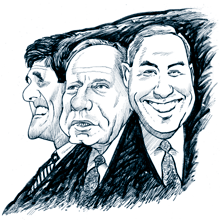
There are just 711 days until the New Hampshire Democratic primary on January
27, 2004. Anyone who wants to run against President George W. Bush in the next
presidential election needs to lay the groundwork in the Granite State right
now. It has long been a political rule of thumb that anyone seeking to capture
the Democratic Party's nomination must win big in New Hampshire. But this time
around, three prominent New England politicians -- Senator John Kerry of
Massachusetts, Senator Joseph Lieberman of Connecticut, and Governor Howard
Dean of Vermont -- are all vying for the spot, which changes the political
implications of the race. Together, the five New England states represent 35
electoral votes, providing a significant chunk of delegates to the Democratic
National Convention in July. That means that if a New Englander wins New
Hampshire, he will also likely win the battle for New England in the race for
the Democratic nomination.
Even for the New Hampshire primary's winner, the Democratic nomination won't be
a sure thing. Four other heavyweights -- former vice-president Al Gore, House
minority leader Richard Gephardt of Missouri, Senate majority leader Tom
Daschle of South Dakota, and Senator John Edwards of North Carolina -- are
being touted as probable presidential candidates. But only New Englanders
Kerry, Lieberman, Dean, and possibly Senator Christopher Dodd of Connecticut
(whose sole focus right now seems to be getting on Don Imus's radio program)
are hoping to use a victory in neighboring New Hampshire to command
regional loyalty in the Northeastern states, propelling them to the front of
the primary pack.
Garrison Nelson, a political-science professor at the University of Vermont,
argues that a regional New England candidate could perform well in 2004. "We're
in play. The New England states are now a player in presidential politics,"
says Nelson, who also teaches New England politics at Boston College. "Now that
the New England states vote more Democratic than the rest of the nation, they
become a unit with 35 electoral votes that can be used to balance off
Pennsylvania, Ohio, or other large states."
The possibility of a battle for New England has largely escaped the notice of
political pundits -- with the exception of Boston Herald columnist Wayne
Woodlief. "New Hampshire could become a kind of New England elimination match
among Kerry, Senator Joe Lieberman of Connecticut [Gore's vice-presidential
running mate in 2000], and Howard Dean," Woodlief observed in a December 16,
2001, column. The stakes are higher than even Woodlief suggests. It goes
without saying that a successful candidate needs to win New Hampshire
resoundingly enough to leave the Granite State with a build-up of momentum. But
the front-loading of primaries in other states (in which their contests would
take place closer in time to New Hampshire's, thus giving the Granite State's
winner an edge), combined with the emerging electoral power of New England in
presidential politics, may also enable a Democratic candidate to ride a New
Hampshire victory all the way to the nomination.
"The good news is that none of them will have to take a plane," says Arnie
Arnesen, a talk-show host on WNTK Radio and WMDS-TV. "They can all cab it."
THERE'S NOTHING NEW in the idea of basing a presidential campaign around a New
England strategy. Kerry, Lieberman, and Dean are all banking that a big New
Hampshire win can do for them what it did for Kennedy in 1960 and Dukakis in
1988. Ambassador Joseph P. Kennedy used his money and political operatives to
rebuild the Democratic Party in New Hampshire, a base that helped propel
Senator John F. Kennedy to the nomination. Ambassador Henry Cabot Lodge, whom
Kennedy had defeated in the 1952 Senate race, swept to victory in 1964 -- only
to be trounced by Senator Barry Goldwater at the Republican convention. (Maine
senator Edmund Muskie, a Democrat, won New Hampshire in 1972, but by only nine
points -- not enough to carry him out of New England. In 1972, due in part to a
publicized episode where Muskie may have cried in front of television cameras,
McGovern came close enough to Muskie to be perceived as the winner.)
Next to Kennedy's example, Massachusetts governor Michael Dukakis's 1988
presidential bid offers the most the most successful case of a New England
politician harnessing the New Hampshire primary to his own advantage. Dukakis,
then propped up by the economic boom known as the Massachusetts Miracle,
boasted a popular reputation in the voter-rich region of Southern New
Hampshire. Dukakis's popularity in the state was boosted by his opposition to
the Seabrook Nuclear Power Plant. The Massachusetts governor won big in New
Hampshire -- beating his closest opponent, Gephardt, by 16 points.
Dukakis's victory in New Hampshire was so compelling that another Massachusetts
Greek, Paul Tsongas, attempted to emulate his campaign model in 1992. With a
voluminous economic plan that appealed to recession-scarred New Hampshire
voters, Tsongas's message caught on in the Granite State. But Tsongas beat his
opponent, Arkansas governor Bill Clinton, by only eight percent. Clinton
declared himself the "Comeback Kid," and the rest is history.
"The Dukakis campaign in 1988 and the Tsongas campaign in 1992 demonstrated
that a head start in New Hampshire can become a head start in the nominating
process as a whole," says Ralph Whitehead, a political analyst based at UMass
Amherst. "If Gephardt and Daschle are in the race, they have a corresponding
advantage in Iowa. That means you may have an Iowa regional contest followed by
a New Hampshire regional contest, and then the winner of Iowa and the winner of
New Hampshire will run off."
That may be wishful thinking, according to some political observers. Thanks to
the machinations of several states, including South Carolina, Michigan,
Arizona, and Virginia, all of which want to move up the date of their primaries
to within a week of New Hampshire's, some political analysts think the
Kennedy-Dukakis strategy is no longer possible. Why, some wonder, would
presidential hopefuls spend an inordinate amount of time in New Hampshire, when
contests in other fought-over primaries are merely a week away? With other,
bigger primaries so close, it is argued, the New Hampshire primary will be
marginalized -- much like the Iowa caucus, a haven only to farm-friendly
candidates.
Not so fast, says Democratic strategist Mary Anne Marsh, who argues that the
nation's voters will still look to flinty New Hampshirites to perform the
quirky, time-honored ritual whereby the state's residents require even the most
high-and-mighty candidates to eat in the town diner and meet in the town hall.
"New Hampshire is still critical," argues Marsh. "The rest of the country still
trusts New Hampshire to vet these candidates. You still need to do retail
campaigning up there."
Besides, if evidence of New Hampshire's continued viability were needed, the
candidates themselves are providing it. Edwards, the North Carolinian, just
visited New Hampshire two weeks ago. Even Reverend Al Sharpton, who is mulling
a Jesse Jackson-like presidential run in 2004, is planning a visit to New
Hampshire.
Now that cable news stations cover American politics 24 hours a day, seven days
a week, New Hampshire could become even more important. Political events that
take place in New Hampshire immediately resonate throughout the national
consciousness. Any political innovation or skillful campaign move that takes
place there will be instantly broadcast across the country. Likewise, any
mistake or misstep could immediately stymie a candidacy.
"This time it looks like, in addition to these three cable networks, you'll
have an even tighter calendar," says Marsh. "You can ride the wave successfully
across the country or, if you make a misstep, it makes it harder to recover."
IF NEW HAMPSHIRE still matters, then which of the three New Englanders is best
positioned to come out on top? They share certain similarities: all three
attended Yale. All three -- even Lieberman, who is Jewish -- have a certain
sober, New England quality. All three, finally, possess overlapping fundraising
and political networks.
Among the three, the early money is on Kerry, who raised almost $4 million
in 2001, the most of any of the potential presidential candidates. For his
part, Dean raised only $111,000. But beyond the early handicapping, each of the
three can make an argument for his winning New Hampshire.
Kerry's strategy for New Hampshire most clearly mirrors the Dukakis model.
Kerry routinely gets television and radio airplay that can be received in the
Massachusetts-like population bases of Nashua and Manchester. And, like Kennedy
before him, Kerry boasts friends in New Hampshire's Democratic structure. Kerry
is scheduled to appear at a New Hampshire Democratic State Party fundraiser on
March 2.
Beyond the advantages Kerry can look to as a senator from a neighboring state,
he also possesses something else. His allies call it "electability." They will
point to his heroic military record as a Naval officer -- including his Silver
Star for service in Vietnam -- and to his having chaired the Senate
Subcommittee on Terrorism, Narcotics, and International Operations, and argue
that he alone among the Democrats has the foreign-policy and military
credentials to go up against President George W. Bush. This electability, for
lack of a better word, allows Kerry to raise money around the country,
including in California. Kerry is also aided by his commitment to
environmentalism -- a touchstone he emphasized when he delivered a speech on
energy security to the Center for National Policy last month.
Kerry, in short, will campaign heavily on his policy strengths: terrorism,
international affairs, and the environment. And while his style on the stump
was at one time somewhat aloof, he has developed a common touch. Whether
cajoling white-headed World War II veterans or schmoozing with rock stars,
Kerry can turn on the charm when he wants to. Again and again, you hear people
say how his manner strikes them as presidential -- no matter what the Boston
reporters like to say.
Like Kerry, Lieberman, who says he will bow to Gore should the former
vice-president run, has proximity to New Hampshire on his side. Unlike Kerry,
however, Lieberman has to fight through the airwaves of another state to reach
New Hampshire voters. Things aren't as bad in this regard for him as they might
have been five or 10 years ago. Today, thanks to New England Cable News, which
has bureaus in Massachusetts, Connecticut, and New Hampshire, Granite State
political junkies can see him frequently. On January 25, for example,
Lieberman, who was initiating a Senate inquiry into the Enron scandal, gave an
extensive interview to the regional cable news network that was replayed
repeatedly throughout the day. While most political analysts assume he can't
reach into New Hampshire from Connecticut, NECN provides him more access to
state voters than people think.
Lieberman might also be helped if his fellow senator and frequent partner in
legislation, John McCain of Arizona, decides not to challenge Bush in 2004.
Both McCain and Lieberman -- who entered the halls of Congress together for
Bush's State of the Union address in January -- occupy the center of American
politics, with McCain at the left of the GOP and Lieberman at the right of the
Democratic Party. Because New Hampshire, like Massachusetts, has an "open
primary" -- meaning independents can select which ballot, Democratic or
Republican, they will take on Election Day -- Lieberman can hope that
independents will go to the polls and vote for him. While he undoubtedly
sustained damage within his base for moving left in order to run with Gore in
2000, he has successfully staked out the right-leaning-moderate ideological
ground within the Democratic Party.
Lieberman comes to the race with a long-standing commitment to moral rigor. He
has been an outspoken critic of Hollywood and was a lone Democratic voice
chastising President Clinton for his affair with Monica Lewinsky. His style on
the stump is somewhat professorial, but his gravitas draws few complaints.
Still, New Hampshire voters tend to look for a little more warmth in their
presidential candidates.
Although Kerry's Vietnam-era war record far outshines anything Lieberman did
during that period, the latter has taken bolder policy positions -- especially
since September 11. He has consistently favored taking on Saddam Hussein, a
position from which Kerry has shied away. If Bush ends up confronting Iraq and
winning, Lieberman's position will serve him well.
If the Connecticut senator hopes his foreign-policy positions will help him in
New Hampshire, he may have more work to do. "We don't hear him," says Arnesen,
a New Hampshire talk-show host. "Do I know what he's carved out in the
foreign-policy front? No, because it's been dominated by the president,
[Secretary of Defense Donald] Rumsfeld, and [National Security Adviser]
Condoleezza Rice."
With both Kerry and Lieberman making a play for the presidency in part on
international issues, Dean will place a Democratic trademark at the center of
his campaign -- health care. Dean is a medical doctor who helped structure a
prescription-drug-purchasing compact wherein Vermont, Maine, and New Hampshire
collectively buy prescription drugs to lower the price for consumers. While
he's from a small, obscure state, his prescription-drug-buying plan is heralded
from Pennsylvania to Kentucky. More important, New Hampshire residents know of
Dean and his involvement in the plan. He has an ideological advantage, too. His
political roots, like those of many New Hampshirites, lie in the old
Rockefeller Republican Party -- left-leaning on social issues, more centrist on
fiscal concerns. As a teen, he accompanied his father to the 1964 Republican
Convention in San Francisco, where right-wing Goldwater delegates overpowered
supporters of Lodge and New York governor Nelson Rockefeller. Horrified, he has
ever since stood firmly behind liberal social positions. For example, Dean
helped navigate Vermont's embrace of civil unions for gay and lesbian couples
-- albeit with the help of the Vermont Supreme Court. For this and other
reasons, he has become strongly identified with gay issues, an asset in his
quest to raise funds and carve out a base of supporters within the Democratic
Party.
And for all his lack of national renown, Dean has begun to win plaudits from
national liberal pundits. "Dean may be on to something," wrote Newsweek
columnist Eleanor Clift on January 4. "His theme is health care and he brings a
perspective that could be just what the doctor ordered."
The most dangerous thing for Dean's opponents is that his political skills --
glad-handing at local town-hall meetings, presenting complicated policy
proposals in a folksy way -- are the same skills that New Hampshire voters tend
to reward. It's easy to imagine him camping out in New Hampshire in the coming
months, addressing small group after small group. He has the advantage over the
other candidates of not having to fly back to Washington; all he has to do is
make the relatively short commute from Montpelier. And Dean possesses another
advantage: his medical background has left him with a warm bedside manner that
could play well in New Hampshire. The combination of Dean's engaging one-on-one
personality and New Hampshire's traditional embrace of mavericks could boost
his primary chances.
"Howard Dean is earnest, Joseph Lieberman is a mensch, and John Kerry is a
star," says one Democratic insider who has met all three.
On the downside for Dean -- in contrast to Kerry, whose actions seep into
Vermont through the Boston media -- the TV stations in his state broadcast in
upstate Vermont and Quebec, leaving him without easy access to New Hampshire
news outlets. Plus, Kerry will be sure to do lots of television advertising
during his 2002 race, even though no Republican opponent has yet emerged to
challenge him. Those ads will saturate Southern New Hampshire less than a year
and a half from the primary -- an advantage none of his presidential rivals can
claim.
KERRY SUPPORTERS are confident their candidate will win the New Hampshire
primary handily. "There are simply not the financial resources for Dean to
break through what will likely be a crowded field," says one Kerry supporter.
"The only way for him to distinguish himself will be as a reformer or a
truth-teller, but those are also credentials shared by Kerry, with his
credentials on campaign-finance reform and the environment. And in the end,
Lieberman's strengths on foreign policy are more than matched by Kerry's
personal history as a decorated veteran, and Al Gore's Hamlet routine will
squeeze off Lieberman's ability to build a campaign infrastructure and base of
financial supporters in time for the presidency."
Alan Solomont, the former finance chair for the Democratic National Committee,
says he likes Kerry's chances. "He brings some assets that are unique -- his
military service along with his record of foreign-policy expertise," says
Solomont. "He's generally staked out positions that are in the middle, and he
doesn't have the baggage that leaders such as Daschle and Gephardt possess."
While the prospect of a New England political battle has the juices of some
political junkies flowing, talk-show host Arnesen says none of the candidates
has captured state voters' imaginations yet. With New Hampshire governor Jeanne
Shaheen running for the Senate, Arnesen's callers have taken to wondering about
which Democratic big shot the governor will call upon for help. "John Kerry is
not going to have cachet for Shaheen, nor Lieberman nor Dean," she says, not
even mentioning Dean. "The only one she could bring in is Martin Sheen [who
plays President Josiah Bartlet on NBC's The West Wing]."
Listen to some political pundits these days and it sounds like Bartlet's the
only New Englander who could be elected president. Many commentators still keep
to the Southern strategy, which holds that only a Southern male moderate --
like Clinton in 1992 -- has the ability to win the entire country.
"The Democratic ticket in 2000 failed to win a commanding victory because it
consisted of two Eastern liberals," notes Whitehead. "In the intervening eight
years, Al Gore had become an Eastern liberal, and Senator Lieberman, while a
moderate by New England standards, is seen by the rest of the country as a New
England ethnic liberal."
For this reason, some analysts are keeping their eyes not on how Kerry,
Lieberman, or Dean does in New Hampshire, but on how well Edwards performs. If
he can come close to Kerry, then he -- not Kerry -- will have won the New
Hampshire expectations game. Remember, Muskie -- not McGovern -- actually won
the New Hampshire primary. And 20 years later, Clinton similarly came close
enough to Tsongas to come out of New Hampshire with momentum.
"The question is to watch John Edwards, Clinton-lite," says Marshall Wittmann,
a political analyst at the officially nonpartisan but rightward-leaning Hudson
Institute. "He now has a soft-populist appeal and will be touted as the guy who
can win. Remember, the Democrats have not won the presidency since 1960 without
a Southerner at the top of the ticket."
It is thinking like this that makes a huge performance -- not just a win -- so
vital to Kerry in New Hampshire. Everyone will be looking to see how he does in
his own back yard. And this is what makes Dean's (and to a lesser extent,
Lieberman's) New England aspirations so dangerous to him. While a New
Englander, Lieberman is running for president as a former vice-presidential
candidate who helped head the Democratic ticket in 2000. His niche, centrist
Democrat, relates more to ideology than geography; in this way he can cut as
much into Edwards's support as into Kerry's. On the other hand, Dean, from
neighboring Vermont, poses a greater geographic threat to Kerry. By dint of
proximity alone, Dean may be able to generate enough buzz to prevent Kerry from
walking away from New Hampshire.
At this point, Dean might want to remember a chapter from his own political
memory. In 1964, New York governor Nelson Rockefeller looked like he was on his
way to the Republican nomination, when Henry Cabot Lodge's son began a write-in
campaign on his father's behalf. Lodge, the Yankee favorite, did well enough to
take the wind out of the sails of Rockefeller, his ideological counterpart --
paving the way for a Goldwater victory. In The Making of the President,
1964, political reporter Theodore White contended that Rockefeller would
have won the nomination had it not been for Lodge. Dean, like Lodge, ultimately
may play the spoiler in New Hampshire.
With less than two years to go, the road to the White House still runs through
New Hampshire. But whether it's a bump on the road or a jump-start to the
presidency remains to be seen. We'll have to see how many of the next 711 days
Kerry, Lieberman, and Dean spend in the Granite State.
Issue Date: February 15 - 21, 2002