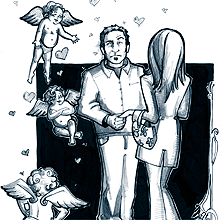
In the early 1980s, British synth-pop star Howard Jones posed a question that
has been haunting poets and philosophers ever since. "What is love, anyway?"
Jones sang. "Does anybody love anybody anyway?" Despite the song's lax poetics
(rhyming anyway with anyway), "What Is Love?" proved to be a
valuable addition to the ongoing debate over the nature of passion, offering up
such insights as, "Maybe love is letting people be just what they want to
be."
Ah, that I could spend just five minutes with Howard Jones today. You see, I've
been asking myself the same question lately. I've been standing in front of the
mirror and saying, "Chris, what is love, anyway?" Unable to get an intelligent
response, I turned to the American Heritage Dictionary:
love (luv).
1. A deep, tender blah blah blah.
2. A feeling of intense yada yada.
3. To have sexual intercourse with.
Fair enough. But surely there is more to love than this. I love breakfast
burritos, but I wouldn't want to have sex with one. Or it would have to be one
fine-looking burrito, if I did. In general, though, we do not love food in the
same way we love human beings. For one thing, our love for humans runs much
deeper and is much more intense. So how to explain the fact that I no longer
love Stacey Chandler the way I did 20 years ago, while my love for breakfast
burritos is just as ardent as it was in 1982? This is complicated stuff. But we
are getting somewhere.
The fact is, my reluctance to be on intimate terms with breakfast foods leads
us to a deceptively simple point: there is more than one kind of love. Indeed,
there may be more than 100 different kinds, ranging from the way we might love
a benevolent God to loving how sparks fly off the wheels of Red Line trains.
This point clarifies matters somewhat, yet we are no closer to figuring out
what love -- romantic love -- is.
It could be that we are simply asking the wrong questions. One line of
philosophical thinking argues that we do not identify things by perceiving what
they are, but rather by perceiving what they aren't. When we see an egg,
the argument goes, we do not think, "Ah! Egg"; we think, "Not candle, not fish,
not Toyota Corolla, not tree, not Tom Brokaw, not foot," until we arrive,
exhausted, at egg. This line of reasoning, while utterly absurd, does provide
us with a clue to the origins of love.
Love does not come to us with a thunderbolt and a choir of angels. We do not
see "the one" and immediately "know." Instead, we move through this world
reciting an unconscious mantra: "Not you, not you, not
you . . . " And then, one day, we see someone and the "Not
you" is conspicuously absent. That is how we arrive at the "You." It is a
simple process of elimination. (Some people are more adept at this than others.
Very lonely or very horny people often ignore the "Not you" altogether, going
on dates with out-of-work toilet attendants who have hairy foreheads and onion
breath.)
So much for the how. A far knottier question is the what.
Freud thought he saw the origins of love in the arousal of newborns as they
suckle at their mothers' breasts. This theory might help explain the titty
obsession of magazines like Maxim, but it's -- well, it's kind of
gross. (I, for one, cannot remember the last time I used the line, "You
have breasts exactly like my mother's.") In his Symposium, Plato argued
that love is a universal longing for beauty -- but ugly people marry, too, do
they not? In The Natural Philosophy of Love, Remy de Gourmont began by
pointing out, "If insects and mammifers have any common ancestor, save the
primordial jelly, there must have been very different potentialities in its
amorphous contours to lead it here into being bee and there into being
giraffe." Thanks, Remy.
Even the great poets fall short in describing what, exactly, love is. John
Donne wrote, "Love, all alike, no season knows, nor clyme,/Nor houres, dayes,
months, which are the rags of time." Nice, but what the hell is he going on
about? And it gets worse. "As fair art thou,/my bonie lass," wrote Robert
Burns. "So deep in luve am I,/And I will luve thee still, my dear,/Till a' the
seas gang dry." Evidently, spelling is not a high priority among versifiers.
And when poets are comprehensible in writing about love, they are more
liable to embarrass than enlighten, what with all their thees and
thous, their oh-woes and wherefores. Shakespeare, the Bard
of Avon, went so far as to use the words "hey nonny, nonny" in a romantic
passage, which is inexcusable. And modern-day songwriters don't fare much
better: "When the moon hits your eye like a big pizza pie, that's
amore." Right. That's chronic alcoholism, more like.
The bottom line is, attempting to define the nature of love is futile, like
asking if the Red Sox will ever win a pennant, or whether Mr. Rogers is gay.
Love is a slippery thing, and my increasing awareness of this fact is causing
me some very real personal problems.
Tora dost daram, say the Farsis. In Iceland, it's Eg elska
thig. From Russia with love: Ya tyebya lyublyu. Easy for some people
to say. I luh. I luh. I luuuuuuh.
I once dated a woman who used "I love you" the way most people use "excuse me"
or "thanks." She said it to friends, co-workers, convenience-store clerks.
Three or four times a week she would call her parents and, without exception,
she would say those three little words: "I need money." No, sorry -- that was
another woman. Without fail, she would end a conversation with her parents by
saying, "Love you, mom," or "Love you, dad."
Meanwhile, I got so used to hearing these words that I once violated
Wright-family etiquette in the most egregious and agonizing way. I was on the
phone with my own mother, who was no doubt regaling me with tales of her latest
yard-sale coup, when I said it: "I love you." There was a silence on the other
end. And then a click. Or maybe she blurted out something similarly dreadful.
To be honest, the whole episode's a blur. Fifteen years later, it still pains
me to think of it. No mention has been made of the incident since, on either
side.
It's not that I don't love my mother, nor she me, but we are just not the kind
of family that uses that word around each other. And yet -- and this is
the truly odd thing -- when it comes to people with whom I've been romantically
involved, I've been downright wanton with the L-word. Off the top of my head, I
can remember saying it to Stacey, Sari, Maria, Suzanne, Nicki, two Marys, Alix,
Beth, Hayley, Helen, and Nina -- a minimum of a dozen I-love-yous. But that was
then.
Today, no matter how hard I try, I simply cannot bring myself to utter these
words. They stick in my throat like a presidential pretzel. Even when I try to
take the coward's way out, I crumble. This very morning, for instance, I sent
my girlfriend -- my You -- an e-
mail
that said: "I want to tell you: you know, I, ahem, do. Do I make myself clear?"
When she responded that no, I do not make myself clear, I replied, and I quote,
"I like you." Pathetic.
In my attempts to understand my newly acquired aversion to the L-word, I
recently found myself entering a chat room frequented by teenage girls, where I
came across the following posting:
Saying I love you should not be taken for granted. When someone says it to
you, you really need to think about what you, or him, is saying. You should not
say I love you if he says it first. If and only if you feel you need to say it
make sure that the both of you understand that it is not the type of dependable
love. In other words; saying I love you, and meaning it is two different
things. You should let the other person know that.
Even though the girl who posted this message is clearly a student of the Robert
Burns school of expository writing, she makes an interesting point: "Saying I
love you and meaning it is two different things." This is where I'm getting
tripped up. Because I did mean it when I told Stacey I loved her, and I
meant it when I said it to Sari, Maria, Suzanne, Nikki, the two Marys, Alix,
Beth, Hayley, Helen, and Nina -- to whom I said it at a wedding ceremony four
years before we ended up in divorce court. Today, I can barely remember what
Nikki looked like.
Saying "I love you" and meaning it are two different things, yes, but so,
apparently, are meaning it and meaning it. I look at my You today and,
you know, I get those feelings. She's lovely. I love the way she makes me feel.
I love her smile and her spirit. I love her ankles and her elbows and her
knees. But I cannot say so. How can I? How can I say it when I can't even be
sure that I mean it?
A friend of mine insists that I'm being too wary about all this. According to
her, there's a tacit understanding among adults that love does not come with a
lifetime -- or even a one-year -- guarantee. You can say the L-word to someone,
mean it at that particular moment, and then change your mind a short while
later with a clear conscience. Which is all well and good, but what about
me?
Today, Sari's living in London with a stockbroker. Helen's dating a coxswain.
Both of the Marys are married, neither one to me. Each of these women, at some
point, professed undying love to yours truly. So how can I be sure the new You
won't go the same way? Well, I can't. And maybe that's okay. After all, I have
no regrets about Sari or Helen or the two Marys. As my friend points out,
everyone wants to feel loved -- or at least that they have been loved.
So maybe I've made a mistake. Lately I've been operating under the impression
that I've been too promiscuous with the L-word in my life, but perhaps the
opposite is true: maybe I've been too sparing with it. It could be that my
mother, far from being horrified the day I let slip with the word, wishes I'd
say it more often. Maybe my girlfriend does, too. So I'd like to take this
opportunity to say a few words to them: like the most affectionate Hessian,
Isch habb disch libb -- till a' the seas gang dry.
Love letters to Chris Wright can be addressed to cwright[a]phx.com.
Issue Date: February 1 - 7, 2002