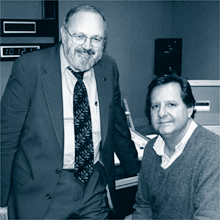
The October 2000 dedication of WRNI's broadcast studio in Providence was
characterized by a celebratory mood and not without good reason. As part of a
capital campaign, Rhode Islanders had contributed $2.2 million to assure the
future of the state's two-year-old public radio station. The development of a
state-of-the-art studio marked a tangible commitment to local broadcasting, and
the debut one month later of One Union Station, a thoughtful
issues-and-ideas program named for WRNI's new location, quickly delivered on
the same kind of expectation.
It was quite a change from the time prior to the advent of WRNI in 1998, when
Rhode Island and Delaware were the only states without their own National
Public Radio affiliates. Thanks to the generosity of listeners and the support
of WRNI's parent, the WBUR Group of Boston, the outlook seemed auspicious for
fans of NPR's intelligent brand of broadcasting.
Like most of the media, WBUR went into overdrive on September 11, focusing its
resources on the most important crisis to hit America in years. The resulting
broadcasts of Special Coverage -- aired weeknights from 7 p.m. to 9 p.m.
on WRNI (AM 1290) and WBUR (90.9 FM) -- have filled a need for information
about the unfolding events, particularly in the weeks immediately after the
attacks on the World Trade Center and the Pentagon. But this rapid response,
which coincided with the suspension of One Union Station and the
reassignment to Boston of 10 staffers from the program, has also come at a
decided cost to WRNI's identity. For about a month after September 11, WRNI
functioned not as an independent voice for Rhode Island, but essentially as a
repeater for WBUR.
If there were plans to restore One Union Station -- and by extension, a
significant commitment to local programming on WRNI -- this could be understood
in the context of the need to cover the aftermath of the terrorist attacks.
WBUR officials, however, are clearly pleased by the success of Special
Coverage -- which has been broadcast at various times by more than 50 NPR
stations -- and it seems bound to serve as the template for a new weekday
evening program that will debut on WBUR and WRNI some time after January 1.WBUR
officials say this as-yet-untitled WRNI-produced program will represent a
combination of Special Coverage and One Union Station, although
they haven't yet decided on the format, general content, or whether the show
will originate from Boston or Providence. Meanwhile, another program -- a
weekly one-hour show that focuses on Rhode Island -- will be launched on WRNI
by the late spring of 2002.
It's impossible to predict exactly how this realignment will shake out.
According to WBUR spokeswoman Mary Stohn, "There's absolutely no possibility
that 'RNI won't be comprehensive, strong, and true to its mission at the end of
this crisis situation that we're in." But some observers suspect that One
Union Station, which previously consisted of 10 hours of weekly coverage,
is about to be marginalized as a one-hour boutique show, and that WBUR's pledge
of robust local programming on WRNI is going out the window.
As noted by Dr. Pablo Rodriguez, medical director of Planned Parenthood of
Rhode Island, who was among those toasting the new studio during the October
2000 reception, "The original intention of WRNI," -- and the message that
accompanied the solicitation of donations -- "was that there was going to be
significant community programming." But the pending changes sound to Rodriguez
as if the station is moving in the wrong direction. "My expectation was that
the local programming would increase, not decrease, when they first began with
One Union Station," he says. "It's a big surprise to me."
Pamela Watts and Jonathan Saltzman
 |
Perhaps the successor to Special Coverage will become a kind of
equivalent of ABC's Nightline -- a program created in response to a
crisis that has gone on to make a lasting contribution. At the same time, Rick
Schwartz, a spokesman for the Rhode Island Foundation, which provides space for
WRNI and has donated $375,000 to the station over the last four years, notes
that the foundation offered support "for local programming, and if their
package at the end of all the discussions is very little local programming,
we're going to be disappointed." So far, Schwartz adds, "I don't think people
have paid that much attention" to the changes at WRNI. "[But] if they come back
on January 1 and say, `by the way, we've decided to eliminate One Union
Station,' I think a lot of people will stand up and take notice."
Some patrons of WRNI are withholding judgment for the time being. Retired
industrialist Henry D. Sharpe Jr., who chaired the $2.2 million capital
campaign, says he would be concerned if the station's focus didn't return to
Rhode Island in the future, but for now, "I think they [WBUR] have to run the
station in very difficult times. I go along with whatever they're trying to
do."
More common, though, is the sentiment expressed by Vivien Hassenfeld, who with
her husband, Alan, chief executive of Pawtucket-based toy manufacturer Hasbro,
donated more than $100,000 to the $2.2 million capital campaign. "I hope they
do go back to topical Rhode Island issues in the future -- I think that was the
goal," Hassenfeld says. "I understand the September 11 coverage; People are
curious and want to be kept updated, but I think there should be discussion of
Rhode Island issues."
Other supporters bristle at the way in which the diminished level of local
programming goes unmentioned on WRNI -- even as listeners were asked for
contributions during a recent fall fund-raiser and resources from the Rhode
Island station continue to be steered to WBUR to help support Special
Coverage. Nor has WBUR diminished efforts to build WRNI's community
profile, rolling out staffers to greet listeners at a WRNI tent during the
WaterFire of October 27. WRNI staffers wouldn't publicly comment about
the overall situation, but there's clearly a level of discontent about the
station's direction.
Some supporters of WRNI express a similar kind of dissatisfaction.
Providence Journal reporter Brian C. Jones, who has donated to WRNI,
calls the plans for a one-hour weekly program about Rhode Island
"embarrassing," and he says the station, after a vigorous investment by Rhode
Islanders, is being misused. "There needs to be a Rhode Island base to this
thing and, if not, the two transmitters just become rebroadcast facilities for
WBUR," Jones says. "I think the whole idea of having National Public Radio in
Rhode Island was more than extending the signal of WBUR, excellent as that
station is."
Jane Christo
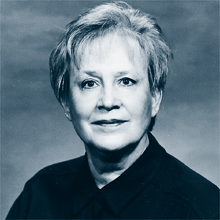 |
There's little doubt that WRNI wouldn't exist if it weren't for the vision of
Jane Christo, the ambitious general manager of the WBUR Group, who has
transformed WBUR from a minor presence into a powerhouse of public radio. And
since WBUR and WRNI are sister stations, some level of sharing of resources
certainly makes sense. Deb Becker and Robert Ames, the respective morning and
afternoon local news anchors on WRNI, broadcast from Boston, not Providence,
for example, and when a story by one of WBUR's reporters is aired on WRNI,
they're identified as part of the WRNI staff, and vice versa. Still, there's a
more important distinction in taking money meant for WRNI and using it at WBUR
-- a precedent established with Special Coverage.
The contention from WBUR officials is that the quality of programming is most
important and it doesn't make much of a difference whether a show originates in
Boston or Providence. As Sam Fleming, the Boston-based news director for WBUR
and WRNI, says, "The audience sees all of this as their product."
Fleming speaks with pride of how WBUR pulled Special Coverage together
in 36 hours in response to a request from National Public Radio, and he
describes the response from listeners as overwhelmingly enthusiastic. "Our big
thing is to give listeners what they want," he says, and citing impressive
growth in WRNI's listenership, he adds, "The kind of growth that we expect down
here is happening."
Fleming describes WBUR's post-January plans for the future of WRNI as
constituting an addition, rather than a diminution, of programming, although
this view seems to lean heavily on interpretation. Since the successor to
Special Coverage will be geared to a combined Rhode Island-Massachusetts
audience, it's fair to suspect that the program will have less of an
orientation toward the Ocean State than One Union Station. Under this
scenario, the new program, plus the one-hour weekly show about Rhode Island,
might represent an expansion of programming, although not of the kind that
contributors to WRNI were led to expect.
ONE UNION STATION was conceived not only as WRNI's marquee
issues-and-ideas program, but also as the destined successor of the Monday
through Thursday 2 to 4 p.m. slot -- the time occupied by NPR's Talk of the
Nation -- on WBUR. Often fascinating under the stewardship of Ray Suarez,
TOTN was decidedly less so after he left for PBS and was succeeded by
Juan Williams, a former Washington Post reporter, whose talents didn't
seem suited to hosting a call-in program. Although the audience for the show
increased by 10 percent during Williams's tenure, according to the Post,
it was dropped from WNYC in New York, removing it from the nation's largest
market.
The original plan was for One Union Station to be picked by WBUR and
then be offered for national distribution -- in the same way that WBUR has
developed other programs, including The Connection, Here and Now,
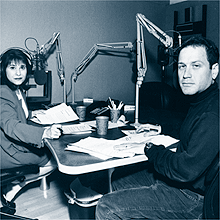
and the latest, Special Coverage. Co-hosted by Jonathan Saltzman, a
former Providence Journal reporter, and former television reporter
Pamela Watts (later joined by WBUR veteran Jill Kaufman), One Union
Station proved a welcome addition to the local airwaves.
As the most ambitious effort on WRNI, OUS represented a serious
expansion in the amount of intelligent broadcasting in Rhode Island. Supplanted
by weekly commentary from such political observers as Scott MacKay of the
Providence Journal and Maureen Moakley of the University of Rhode
Island, the co-hosts provided a strong foundation for the program, which parsed
topics as varied as opera singer Maria Callas, violence in Northern Ireland,
extreme sports, author Richard Wright, and contemporary dating. And even if the
show wasn't purely local in its orientation, the fact that it originated
locally seemed to count for a lot.
"I think one of the strengths of One Union Station was that it
definitely felt like it was coming from here," says Gene Mihaly, president of
the Foundation for Ocean State Radio, which helped to set the stage for the
launch of WRNI, and a professor at the Tuck School of Business at Dartmouth
College. "Here was an entity that was really digging to find out what concerns
the state and how people feel about it." Most importantly, as Mihaly notes,
One Union Station was intended as the foundation for the development of
additional local programming on WRNI.
But even in the time before Osama bin Laden became a household name, there
were signs that the staff of OUS was overburdened and, although they
remain elliptical in their criticism, officials at WBUR acknowledge they
weren't entirely satisfied with the program. Significant changes were
considered in the months before September 11, such as cutting the program to
one hour a day or taking it off the air for a period of fine-tuning and
reconsideration.
Meanwhile, word came that Williams was leaving Talk of the Nation as of
August 30, and his replacement to be was the well-regarded Neal Conan of NPR's
Weekly Edition. Although Fleming describes the two things as unrelated,
some observers say that WBUR's plans for picking up One Union Station
vanished with Conan's arrival at TOTN -- a plausible theory given the
way that NPR supported Christo during her highly publicized battle with former
Connection host Christopher Lydon earlier this year. Then, as the events
of September 11 unfolded, NPR went with live, extended coverage, and One
Union Station hasn't been heard from since.
The licenses for WBUR and WRNI are held by Boston University, and the
Boston-based parent station was once a relatively inconsequential presence.
Praised as a visionary leader by some and feared by others, Christo pioneered
WBUR's rise as one of the first 24-hour all-news-and-information public radio
stations and built a string of stations with more than five million listeners
in eastern Massachusetts, Cape Cod, and Rhode Island. And although the WBUR
Group is home to many excellent reporters -- such as Martha Bebinger at WRNI --
it's clear that the primary emphasis is on the development of long-form
programs, like The Connection, that can be offered for national
distribution.
Although Special Coverage was cobbled together in response to the need
for immediate news, the two-hour format with calls from listeners, analysis,
and audio diaries is seen within WBUR as having legs. The effort isn't without
its critics. Mourning Lydon's departure from The Connection, Robert
Whitcomb, editorial page editor of the Providence Journal, recently
wrote that, "NPR's relentlessly repetitive Special Coverage may set the
pace for endlessly elaborated psychobabble on our reactions, or what they're
supposed to be, `to the tragic events of September 11.' " This seems overly
harsh, though, and Special Coverage has steadily offered in-depth
examinations of such important topics as the tribal culture of Afghanistan, the
Palestinian question, and the end of the post-Cold War era, while highlighting
the formidable analytical abilities of author and Atlantic magazine
editor Jack Beatty.
One clear winner in the situation is Tom Ashbrook, a former Boston Globe
foreign editor, who was a finalist to succeed Lydon as host of The
Connection. Landing the gig as host of Special Coverage, Ashbrook is
regarded as a new favorite within WBUR and he seems likely to have a presence
in the new post-January program. Offered free for the time being to NPR
affiliates, Special Coverage has also represented a coup for WBUR, and
the station will doubtlessly try to convert the new program into something that
can be offered for national distribution.
There's no doubt that WBUR has been a source of excellent coverage during the
aftermath of September 11. Fleming, for example, points to how former Marine
general Bernard Trainor, appearing on Here and Now on October 23,
diagnosed shortcomings in the US military campaign -- days before the same
story received prominent attention in the Boston Globe and New York
Times. Again and again, the mantra from WBUR officials is that this story
has been too important to put aside.
There does come a point, though, when it's important to cover other stories,
and for four or five weeks after September 11, the local news content on WRNI
-- despite the station's fundraising pledge to deliver more than just headlines
-- consisted of just that, along with the brief weekly interview with
Journal political columnist M. Charles Bakst or a similarly short bit of
audio.
"Obviously, the national preoccupation with the attack on America and the
aftermath is important," says H. Philip West Jr., executive director of Common
Cause of Rhode Island, "but what's been lost is any kind of stories about
redistricting -- which is going to shape our political destiny for the next
decade in Rhode Island -- about the ethics commission, where the governor and
the legislative leaders are slow in making appointments. It's as if these Rhode
Island issues have simply dropped off the table."
To be fair, WRNI has largely restored its local news report in the last two
weeks, and former One Union Station co-host Watts has joined Bebinger
and Av Harris on the award-winning reporting staff -- a sign of a renewed
emphasis by WBUR. It's worth noting that WBUR has also hired a new general
manager for WRNI, Anna Kosoff, a veteran of Philadelphia's WHYY. But most of
the OUS staff is expected to remain assigned to Boston until at least
January 1.
West and other observers remain concerned that the new programming will be too
broadly defined to offer a close and extended focus on Rhode Island. "It
strikes me that the whole point of a Rhode Island station was to give
significant amounts of time to Rhode Island issues that are the primary focus
of people in Rhode Island," he says. "As a regular contributor to WRNI, I am
disappointed."
Judging by the response, it was clear that Rhode Islanders were hungry for
public radio after WBUR shelled out more than $2 million to turn WRCP, a
5000-watt commercial station with Spanish-language programming, into WRNI.
Support was widespread, from such community institutions as the Providence
Journal to philanthropists, East Side liberals, and businesses. With help
from these backers and listeners -- who pay for more than half of the station's
$2.5 million budget -- WRNI is supposed to become self-supporting within two
years.
Certainly, there are some listeners in Rhode Island who would be pretty happy
just to receive WBUR. But there are many more who want -- and have every right
to expect -- a strong local commitment from their public radio station.
Ian Donnis can be reached at idonnis[a]phx.com.
Issue Date: November 2 - 8, 2001